
Fresh Projects is a UK-based software platform designed for architects, engineers, and other built-environment professionals to manage financial aspects of their projects. It helps teams track fees, timesheets, expenses, billing, and overall profitability to keep projects on budget and profitable. The platform also centralises project data, streamlines administrative tasks, and offers mobile app support for easy access and updates.
1a Colinette Road
London
SW15 6QG
© 2026 Fresh Projects
Product
Fresh Projects is a UK-based software platform designed for architects, engineers, and other built-environment professionals to manage financial aspects of their projects. It helps teams track fees, timesheets, expenses, billing, and overall profitability to keep projects on budget and profitable. The platform also centralises project data, streamlines administrative tasks, and offers mobile app support for easy access and updates.
1a Colinette Road
London
SW15 6QG
© 2026 Fresh Projects
Product
An Architect’s Guide to Project Budgeting
An Architect’s Guide to Project Budgeting
An Architect’s Guide to Project Budgeting
Reading Time:
Reading Time:
5
5
minute(s)
minute(s)

Creating accurate project budgets can feel deceptively difficult.
Architectural practices have to account for a wide range of variables, from staff time and overheads to programme changes and market conditions. Balancing realism with profitability requires both commercial discipline and up-to-date insight.
Budgeting is not just an administrative exercise. It is one of the most important foundations of a viable and profitable practice.
Why project budgeting matters
Most people enter architecture because they want to design thoughtful, well-crafted buildings. Commercial realities often come later.
While design ambition is essential, the ability to turn ideas into financially viable projects is what allows a practice to survive and grow. Without accurate budgeting, even the best work can undermine the long-term health of the business.
Project budgets matter because they allow you to assess feasibility early. At the budgeting stage, you can identify which elements of a project are driving cost and determine whether the work is realistic in its current form.
If a project is not financially viable, the options are clear. Adjust the scope until it becomes realistic, or walk away.
Beyond feasibility, budgeting also allows you to assess profitability. A practice that consistently breaks even has no buffer for risk, investment or downturns. While occasional low-margin projects may make sense for strategic or reputational reasons, they cannot form the backbone of a sustainable business.
Accurate budgeting underpins both project success and practice longevity.
Budgeting and the RIBA Plan of Work
The RIBA Plan of Work provides a clear framework for how construction projects progress from concept to completion.
Budgeting plays a critical role early in this process, particularly during Stage 1: Preparation and Briefing. This is where initial ideas are shaped into a deliverable and achievable project.
At this stage, the practice defines:
Project outcomes
Quality aspirations
Sustainability goals
Spatial requirements
Feasibility and financial constraints
Agreeing a realistic project budget at this point creates the financial framework for everything that follows. It ensures ambitions are aligned with resources and helps avoid costly corrections later.
Effective budgeting translates strategic intent into a practical delivery plan.
Budgeting from the bottom up
A project budget represents the total estimated cost of delivering a project across all stages.
It should be treated as a living document. Budgets need to be monitored, reviewed and updated as projects evolve.
When evaluating potential work, architects must first establish a clear scope of services and then calculate the cost of delivering that scope.
A bottom-up approach is essential. This involves:
Defining the services required to deliver value
Estimating the time required by role and stage
Applying accurate cost rates
Accounting for additional expenses
Labour costs are typically the largest component. These should be calculated by multiplying estimated hours by fully loaded cost rates that include overheads and non-productive time.
Other costs may include sub-consultants, printing, travel and specialist inputs.
If the cost to deliver exceeds the value created, the project should be reconsidered. These situations often lead to difficult relationships, where clients feel overcharged and practices feel underpaid.
Once delivery costs are understood, fees can be calculated. At a minimum, fees must cover costs. Sustainable practices aim to do more than that.
Establish a realistic project timeline
Complex projects involve many interdependent tasks. A clear timeline helps teams manage this complexity.
Project timelines provide a structured overview of tasks, milestones and dependencies. They allow teams to understand what must be completed and when, and help identify risks before they become issues.
Visual timelines also improve communication. They give project teams and stakeholders a shared reference point and support better coordination.
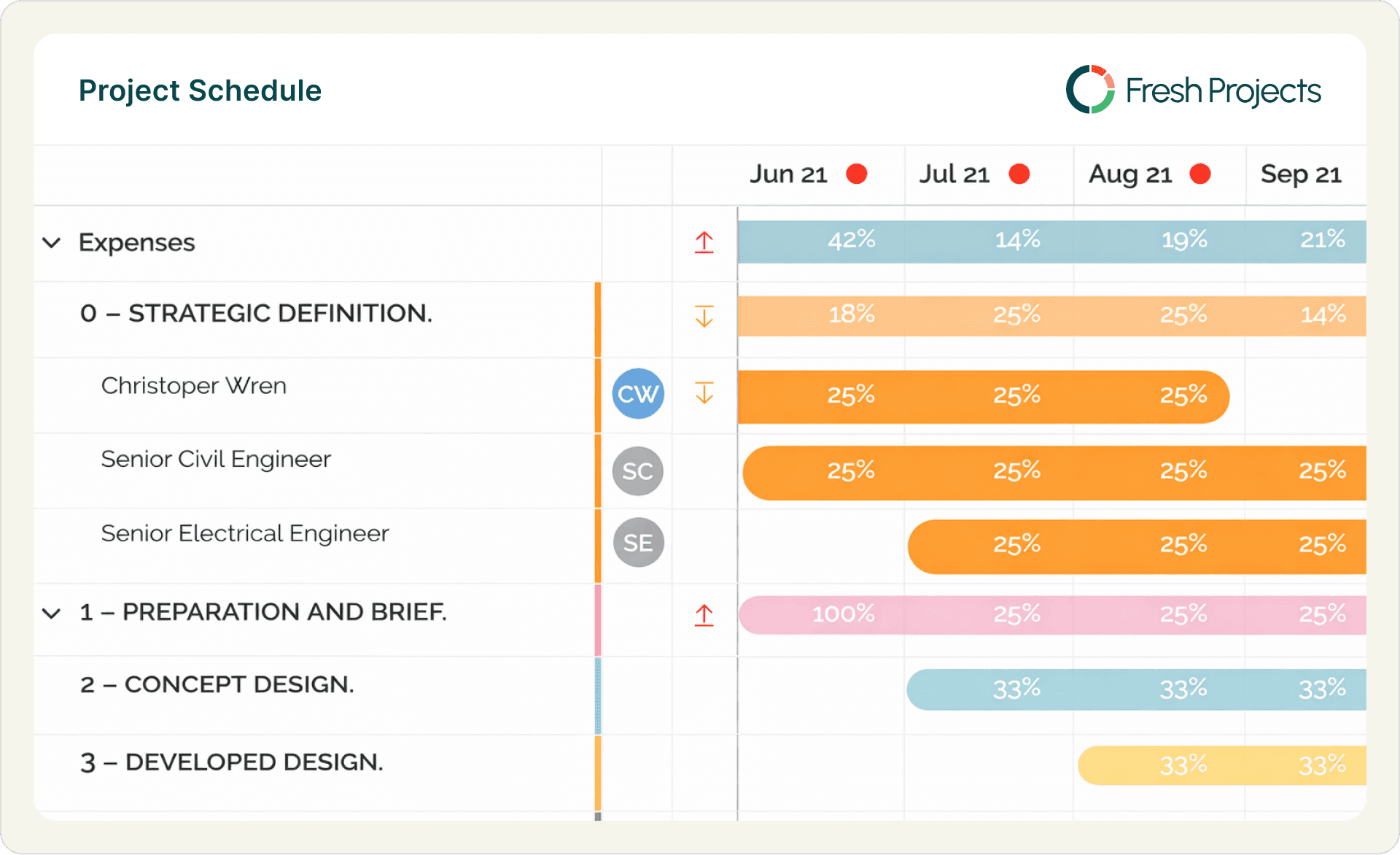
Fresh Projects includes scheduling and resource planning tools aligned to RIBA stages, allowing practices to plan time and people together, rather than in isolation.
The economics of the construction market
Market conditions have a direct impact on project budgets.
Labour costs continue to fluctuate as skilled resource remains constrained across the industry. Planning delays, procurement challenges and supply pressures add further uncertainty.
While no forecast is perfect, practices still need to make informed assumptions. Ignoring market conditions does not remove risk. It simply hides it.
The goal is not precision, but realism.
How to build better project budgets
Improving budgeting accuracy starts with learning from past work.
Review completed projects and compare original budgets with actual outcomes. Look at historic timesheet data, costs incurred and fees recovered. Identify where assumptions were accurate and where they fell short.
This historical insight is one of the most powerful tools available to practices.
Templates can help, but they are only effective if they reflect how your practice actually operates. Budgets should include:
A clear list of services
Stage-based allocations
Realistic time allowances
Known risks and assumptions
Standard RIBA contracts provide a useful reference point when structuring services and scope.
A comprehensive view of your projects
Project budgeting does not exist in isolation. It connects directly to pricing, resourcing, time tracking and forecasting.
Fresh Projects brings these elements together in a single system, allowing practices to:
Build project budgets based on real cost data
Track time and expenses against budget
Plan resources across project stages
Compare projected and actual costs
Improve future estimates using historic data
Having this visibility helps practices budget with confidence and make better decisions earlier.
If you would like to see how Fresh Projects supports accurate project budgeting and profitability, you can book a 30-minute demo.
Creating accurate project budgets can feel deceptively difficult.
Architectural practices have to account for a wide range of variables, from staff time and overheads to programme changes and market conditions. Balancing realism with profitability requires both commercial discipline and up-to-date insight.
Budgeting is not just an administrative exercise. It is one of the most important foundations of a viable and profitable practice.
Why project budgeting matters
Most people enter architecture because they want to design thoughtful, well-crafted buildings. Commercial realities often come later.
While design ambition is essential, the ability to turn ideas into financially viable projects is what allows a practice to survive and grow. Without accurate budgeting, even the best work can undermine the long-term health of the business.
Project budgets matter because they allow you to assess feasibility early. At the budgeting stage, you can identify which elements of a project are driving cost and determine whether the work is realistic in its current form.
If a project is not financially viable, the options are clear. Adjust the scope until it becomes realistic, or walk away.
Beyond feasibility, budgeting also allows you to assess profitability. A practice that consistently breaks even has no buffer for risk, investment or downturns. While occasional low-margin projects may make sense for strategic or reputational reasons, they cannot form the backbone of a sustainable business.
Accurate budgeting underpins both project success and practice longevity.
Budgeting and the RIBA Plan of Work
The RIBA Plan of Work provides a clear framework for how construction projects progress from concept to completion.
Budgeting plays a critical role early in this process, particularly during Stage 1: Preparation and Briefing. This is where initial ideas are shaped into a deliverable and achievable project.
At this stage, the practice defines:
Project outcomes
Quality aspirations
Sustainability goals
Spatial requirements
Feasibility and financial constraints
Agreeing a realistic project budget at this point creates the financial framework for everything that follows. It ensures ambitions are aligned with resources and helps avoid costly corrections later.
Effective budgeting translates strategic intent into a practical delivery plan.
Budgeting from the bottom up
A project budget represents the total estimated cost of delivering a project across all stages.
It should be treated as a living document. Budgets need to be monitored, reviewed and updated as projects evolve.
When evaluating potential work, architects must first establish a clear scope of services and then calculate the cost of delivering that scope.
A bottom-up approach is essential. This involves:
Defining the services required to deliver value
Estimating the time required by role and stage
Applying accurate cost rates
Accounting for additional expenses
Labour costs are typically the largest component. These should be calculated by multiplying estimated hours by fully loaded cost rates that include overheads and non-productive time.
Other costs may include sub-consultants, printing, travel and specialist inputs.
If the cost to deliver exceeds the value created, the project should be reconsidered. These situations often lead to difficult relationships, where clients feel overcharged and practices feel underpaid.
Once delivery costs are understood, fees can be calculated. At a minimum, fees must cover costs. Sustainable practices aim to do more than that.
Establish a realistic project timeline
Complex projects involve many interdependent tasks. A clear timeline helps teams manage this complexity.
Project timelines provide a structured overview of tasks, milestones and dependencies. They allow teams to understand what must be completed and when, and help identify risks before they become issues.
Visual timelines also improve communication. They give project teams and stakeholders a shared reference point and support better coordination.
Fresh Projects includes scheduling and resource planning tools aligned to RIBA stages, allowing practices to plan time and people together, rather than in isolation.
The economics of the construction market
Market conditions have a direct impact on project budgets.
Labour costs continue to fluctuate as skilled resource remains constrained across the industry. Planning delays, procurement challenges and supply pressures add further uncertainty.
While no forecast is perfect, practices still need to make informed assumptions. Ignoring market conditions does not remove risk. It simply hides it.
The goal is not precision, but realism.
How to build better project budgets
Improving budgeting accuracy starts with learning from past work.
Review completed projects and compare original budgets with actual outcomes. Look at historic timesheet data, costs incurred and fees recovered. Identify where assumptions were accurate and where they fell short.
This historical insight is one of the most powerful tools available to practices.
Templates can help, but they are only effective if they reflect how your practice actually operates. Budgets should include:
A clear list of services
Stage-based allocations
Realistic time allowances
Known risks and assumptions
Standard RIBA contracts provide a useful reference point when structuring services and scope.
A comprehensive view of your projects
Project budgeting does not exist in isolation. It connects directly to pricing, resourcing, time tracking and forecasting.
Fresh Projects brings these elements together in a single system, allowing practices to:
Build project budgets based on real cost data
Track time and expenses against budget
Plan resources across project stages
Compare projected and actual costs
Improve future estimates using historic data
Having this visibility helps practices budget with confidence and make better decisions earlier.
If you would like to see how Fresh Projects supports accurate project budgeting and profitability, you can book a 30-minute demo.
Published:
Published:


Why Reporting Still Leaves Architecture and Engineering Firms Guessing
Why Reporting Still Leaves Architecture and Engineering Firms Guessing
Why Reporting Still Leaves Architecture and Engineering Firms Guessing
Inside many built environment firms, meetings meant for decisions quietly turn into debates about the numbers on the page.
Inside many built environment firms, meetings meant for decisions quietly turn into debates about the numbers on the page.
Read More
Read More

If One Office Says “That’s Not How We Do It”, Leadership is Flying Blind
If One Office Says “That’s Not How We Do It”, Leadership is Flying Blind
If One Office Says “That’s Not How We Do It”, Leadership is Flying Blind
In many built environment consultancies, reporting technically works. The challenge is that clarity often arrives after the moment when it would have influenced action.
In many built environment consultancies, reporting technically works. The challenge is that clarity often arrives after the moment when it would have influenced action.
Read More
Read More

Why Reporting Still Slows Down Established Firms Delivering Services in the Built Environment
Why Reporting Still Slows Down Established Firms Delivering Services in the Built Environment
Why Reporting Still Slows Down Established Firms Delivering Services in the Built Environment
Even with reporting systems in place, many architecture, engineering and quantity surveying firms find that insight arrives too late to influence decisions during delivery.
Even with reporting systems in place, many architecture, engineering and quantity surveying firms find that insight arrives too late to influence decisions during delivery.
Read More
Read More

How to Compare Practice Management Tools for Architect and Engineering Firms in 2026
How to Compare Practice Management Tools for Architect and Engineering Firms in 2026
How to Compare Practice Management Tools for Architect and Engineering Firms in 2026
Choosing a practice management system is no longer about feature lists. This guide explains how architecture and engineering firms should compare tools in 2026, focusing on adoption, usability and decision-making rather than complexity.
Choosing a practice management system is no longer about feature lists. This guide explains how architecture and engineering firms should compare tools in 2026, focusing on adoption, usability and decision-making rather than complexity.
Read More
Read More

Autumn Budget 2025: What It Means for Architecture and Engineering Firms
Autumn Budget 2025: What It Means for Architecture and Engineering Firms
Autumn Budget 2025: What It Means for Architecture and Engineering Firms
Implications for resourcing, margins and medium-term planning
Implications for resourcing, margins and medium-term planning
Read More
Read More

How Larger Architecture and Engineering Firms Stay Profitable in a Slower Construction Market
How Larger Architecture and Engineering Firms Stay Profitable in a Slower Construction Market
How Larger Architecture and Engineering Firms Stay Profitable in a Slower Construction Market
What 50–100 person practices are tightening up when pipelines soften
What 50–100 person practices are tightening up when pipelines soften
Read More
Read More

Why Traditional Reporting is Holding A&E Firms Back
Why Traditional Reporting is Holding A&E Firms Back
Why Traditional Reporting is Holding A&E Firms Back
Why Traditional Reporting is Holding A&E Firms Back
Why Traditional Reporting is Holding A&E Firms Back
Read More
Read More

Spreadsheets in A&E Firms: Usage, Key Features, and Underappreciated Gems
Spreadsheets in A&E Firms: Usage, Key Features, and Underappreciated Gems
Spreadsheets in A&E Firms: Usage, Key Features, and Underappreciated Gems
A practical guide to using Excel and Sheets well, and knowing when to graduate to purpose-built systems without losing the flexibility you love.
A practical guide to using Excel and Sheets well, and knowing when to graduate to purpose-built systems without losing the flexibility you love.
Read More
Read More

Breaking Barriers in AEC: Meet the Women Driving Fresh Projects
Breaking Barriers in AEC: Meet the Women Driving Fresh Projects
Breaking Barriers in AEC: Meet the Women Driving Fresh Projects
Why representation, visibility and better systems matter for the future of architecture and engineering
Why representation, visibility and better systems matter for the future of architecture and engineering
Read More
Read More

Legacy Firms, Future Focus: Why Architecture’s Crossroads Is a Leadership Moment
Legacy Firms, Future Focus: Why Architecture’s Crossroads Is a Leadership Moment
Legacy Firms, Future Focus: Why Architecture’s Crossroads Is a Leadership Moment
How firm leaders can protect margin, prepare successors and modernise delivery without losing what made them successful
How firm leaders can protect margin, prepare successors and modernise delivery without losing what made them successful
Read More
Read More

Outgrowing Spreadsheets: 5 Ways to Maintain Profitability as Your Firm Grows
Outgrowing Spreadsheets: 5 Ways to Maintain Profitability as Your Firm Grows
Outgrowing Spreadsheets: 5 Ways to Maintain Profitability as Your Firm Grows
How architecture and engineering practices protect margin as teams and project complexity increase
How architecture and engineering practices protect margin as teams and project complexity increase
Read More
Read More

The Profitability Pyramid: Where UK Architecture Firms Make and Lose Money
The Profitability Pyramid: Where UK Architecture Firms Make and Lose Money
The Profitability Pyramid: Where UK Architecture Firms Make and Lose Money
Understanding the real drivers of financial performance for medium and large practices over the past year
Understanding the real drivers of financial performance for medium and large practices over the past year
Read More
Read More

3 Lessons to Help You Run a More Profitable Practice
3 Lessons to Help You Run a More Profitable Practice
3 Lessons to Help You Run a More Profitable Practice
Practical insights from A&E leaders on spotting profit risks early, communicating value, and protecting margins
Practical insights from A&E leaders on spotting profit risks early, communicating value, and protecting margins
Read More
Read More

Embracing Neurodiversity in Architecture
Embracing Neurodiversity in Architecture
Embracing Neurodiversity in Architecture
How inclusive practice design can unlock creativity, innovation and operational clarity
How inclusive practice design can unlock creativity, innovation and operational clarity
Read More
Read More

Profitable Projects: Winning the Right Projects in AEC
Profitable Projects: Winning the Right Projects in AEC
Profitable Projects: Winning the Right Projects in AEC
How to qualify leads, focus your pipeline and forecast success more confidently
How to qualify leads, focus your pipeline and forecast success more confidently
Read More
Read More

Profitable Projects: The Art of Cashflow Alchemy in AEC
Profitable Projects: The Art of Cashflow Alchemy in AEC
Profitable Projects: The Art of Cashflow Alchemy in AEC
How architecture and engineering firms can turn unpredictable cash flow into a strategic advantage
How architecture and engineering firms can turn unpredictable cash flow into a strategic advantage
Read More
Read More

Profitable Projects: A Three-Part Series on AEC Profitability - Setting the Right Fee for Success
Profitable Projects: A Three-Part Series on AEC Profitability - Setting the Right Fee for Success
Profitable Projects: A Three-Part Series on AEC Profitability - Setting the Right Fee for Success
Why bottom-up fee setting, clear scope and real-time cost visibility underpin profitable projects
Why bottom-up fee setting, clear scope and real-time cost visibility underpin profitable projects
Read More
Read More

How Firm Management Tools for Architects and Engineers Drastically Increase Profits
How Firm Management Tools for Architects and Engineers Drastically Increase Profits
How Firm Management Tools for Architects and Engineers Drastically Increase Profits
Why better visibility across projects, people and finances is now essential for sustainable practice performance
Why better visibility across projects, people and finances is now essential for sustainable practice performance
Read More
Read More

How to Manage Inflation on Architecture Projects
How to Manage Inflation on Architecture Projects
How to Manage Inflation on Architecture Projects
Practical ways to protect fees and margins when costs change mid-project
Practical ways to protect fees and margins when costs change mid-project
Read More
Read More
An Architect’s Guide to Project Budgeting
An Architect’s Guide to Project Budgeting
An Architect’s Guide to Project Budgeting
How to build realistic, profitable project budgets that support better pricing and delivery
How to build realistic, profitable project budgets that support better pricing and delivery
Read More
Read More

An Architect’s Guide to Managing Scope Creep
An Architect’s Guide to Managing Scope Creep
An Architect’s Guide to Managing Scope Creep
How to protect fees, margins and client relationships when projects change
How to protect fees, margins and client relationships when projects change
Read More
Read More

Improve Project Profitability: An Architect’s Guide
Improve Project Profitability: An Architect’s Guide
Improve Project Profitability: An Architect’s Guide
Practical ways architecture practices can protect margins and make better commercial decisions
Practical ways architecture practices can protect margins and make better commercial decisions
Read More
Read More

Pricing Methods for Architects: How to Price Architecture Services
Pricing Methods for Architects: How to Price Architecture Services
Pricing Methods for Architects: How to Price Architecture Services
When to use hourly rates, fixed fees or percentage pricing, and how to choose with confidence
When to use hourly rates, fixed fees or percentage pricing, and how to choose with confidence
Read More
Read More

Calculate Your Cost Rate in 3 Simple Steps
Calculate Your Cost Rate in 3 Simple Steps
Calculate Your Cost Rate in 3 Simple Steps
Why understanding your true cost rate is the foundation of profitable fees, resourcing and decision-making
Why understanding your true cost rate is the foundation of profitable fees, resourcing and decision-making
Read More
Read More

When to Hire? Three Factors That Will Change How You Think About Resourcing
When to Hire? Three Factors That Will Change How You Think About Resourcing
When to Hire? Three Factors That Will Change How You Think About Resourcing
Why workload visibility and forecasting matter more than instinct in mid-sized architecture practices
Why workload visibility and forecasting matter more than instinct in mid-sized architecture practices
Read More
Read More

Didn’t Reach Your Profit Goals Last Year? Get These 5 Basics Right This Year
Didn’t Reach Your Profit Goals Last Year? Get These 5 Basics Right This Year
Didn’t Reach Your Profit Goals Last Year? Get These 5 Basics Right This Year
Five practical habits that help architecture practices improve profitability without adding complexity
Five practical habits that help architecture practices improve profitability without adding complexity
Read More
Read More

3 Questions Every Profitable Architecture Practice Can Answer
3 Questions Every Profitable Architecture Practice Can Answer
3 Questions Every Profitable Architecture Practice Can Answer
How clear insight into projects, clients and utilisation drives better decisions in mid-sized A&E firms
How clear insight into projects, clients and utilisation drives better decisions in mid-sized A&E firms
Read More
Read More

Is There a Secret to Being a Profitable Architecture Practice?
Is There a Secret to Being a Profitable Architecture Practice?
Is There a Secret to Being a Profitable Architecture Practice?
Why the most profitable firms spend less time on financial management and still make better decisions
Why the most profitable firms spend less time on financial management and still make better decisions
Read More
Read More

The “A Team” Approach: How a Simple Change Can Improve Profitability
The “A Team” Approach: How a Simple Change Can Improve Profitability
The “A Team” Approach: How a Simple Change Can Improve Profitability
Why reallocating work across roles can dramatically improve utilisation and margins in 50–100 person A&E practices
Why reallocating work across roles can dramatically improve utilisation and margins in 50–100 person A&E practices
Read More
Read More

I Love Excel. I Hate Excel.
I Love Excel. I Hate Excel.
I Love Excel. I Hate Excel.
Why spreadsheets break down in 50–100 person architecture and engineering practices, and what works better
Why spreadsheets break down in 50–100 person architecture and engineering practices, and what works better
Read More
Read More

Getting Project Fees Right in Large Architecture and Engineering Firms
Getting Project Fees Right in Large Architecture and Engineering Firms
Getting Project Fees Right in Large Architecture and Engineering Firms
How accurate budgeting and disciplined scope control protect profitability in 50–100 person A&E practices
How accurate budgeting and disciplined scope control protect profitability in 50–100 person A&E practices
Read More
Read More

Why Hidden Working Capital Is the Silent Risk in Large Architecture and Engineering Firms
Why Hidden Working Capital Is the Silent Risk in Large Architecture and Engineering Firms
Why Hidden Working Capital Is the Silent Risk in Large Architecture and Engineering Firms
The financial blind spot that catches even well-run architecture and engineering practices
The financial blind spot that catches even well-run architecture and engineering practices
Read More
Read More

How Large Architecture and Engineering Firms Win More of the Right Jobs
How Large Architecture and Engineering Firms Win More of the Right Jobs
How Large Architecture and Engineering Firms Win More of the Right Jobs
How Large Architecture and Engineering Firms Win More of the Right Jobs
How Large Architecture and Engineering Firms Win More of the Right Jobs
Read More
Read More
Fresh Projects is a UK-based software platform designed for architects, engineers, and other built-environment professionals to manage financial aspects of their projects. It helps teams track fees, timesheets, expenses, billing, and overall profitability to keep projects on budget and profitable. The platform also centralises project data, streamlines administrative tasks, and offers mobile app support for easy access and updates.
1a Colinette Road
London
SW15 6QG
© 2026 Fresh Projects
Product
