
Fresh Projects is a UK-based software platform designed for architects, engineers, and other built-environment professionals to manage financial aspects of their projects. It helps teams track fees, timesheets, expenses, billing, and overall profitability to keep projects on budget and profitable. The platform also centralises project data, streamlines administrative tasks, and offers mobile app support for easy access and updates.
1a Colinette Road
London
SW15 6QG
© 2026 Fresh Projects
Product
Fresh Projects is a UK-based software platform designed for architects, engineers, and other built-environment professionals to manage financial aspects of their projects. It helps teams track fees, timesheets, expenses, billing, and overall profitability to keep projects on budget and profitable. The platform also centralises project data, streamlines administrative tasks, and offers mobile app support for easy access and updates.
1a Colinette Road
London
SW15 6QG
© 2026 Fresh Projects
Product
Profitable Projects: Winning the Right Projects in AEC
Profitable Projects: Winning the Right Projects in AEC
Profitable Projects: Winning the Right Projects in AEC
Reading Time:
Reading Time:
4
4
minute(s)
minute(s)

Profitable Projects: A Three-Part Series on AEC Profitability
Welcome to the final instalment of Profitable Projects, a three-part series designed to help Architecture, Engineering and Construction firms improve long-term financial performance.
Across the series, we have explored three fundamentals of AEC profitability:
Winning the Right Projects (you are here)
In this final chapter, we focus on how selecting the right projects and the right clients underpins everything else. Even strong fee setting and cash flow discipline struggle to compensate for a pipeline full of the wrong work.
Why winning the right projects matters
Securing work is essential. Securing the right work is what sustains profitability.
Too many AEC firms fall into the trap of pursuing every opportunity that comes through the door. This spreads resources thin, increases bid costs and often leads to projects that are difficult to deliver profitably.
Winning the right projects means aligning opportunities with your firm’s expertise, capacity and commercial goals.
Manage your pipeline with intent
A healthy pipeline does not happen by accident. It requires active management and clear prioritisation.
Segment and categorise leads
Basic pipeline management starts with maintaining a list of leads and opportunities. To improve profitability, firms need to go further and categorise opportunities by:
Sector
Client type
Project size and complexity
This segmentation makes it easier to focus effort on opportunities that align with your firm’s strengths and historical performance.
For example, a mid-sized architecture firm specialising in high-end residential work segmented its pipeline by client type and project complexity. By focusing on projects with higher margins and better fit, the firm reduced bid effort while increasing overall profitability.
Qualify leads before committing resources
Lead qualification is one of the most powerful levers for improving profitability.
Not every opportunity is worth pursuing. Chasing low-probability or poorly aligned projects consumes time, increases risk and distracts teams from higher value work.
Key criteria for qualifying leads
Leads should be assessed against four core criteria:
Capability
Does the project align with your firm’s technical expertise and delivery experience?
Profit potential
Will the proposed fee realistically cover delivery costs, risks and potential scope change?
Likelihood of success
What is your historical win rate for similar projects, sectors or clients?
Client history
Does the client have a record of timely payment, clear decision-making and controlled scope?
Here is how some firms operationalise qualification using Fresh Projects.
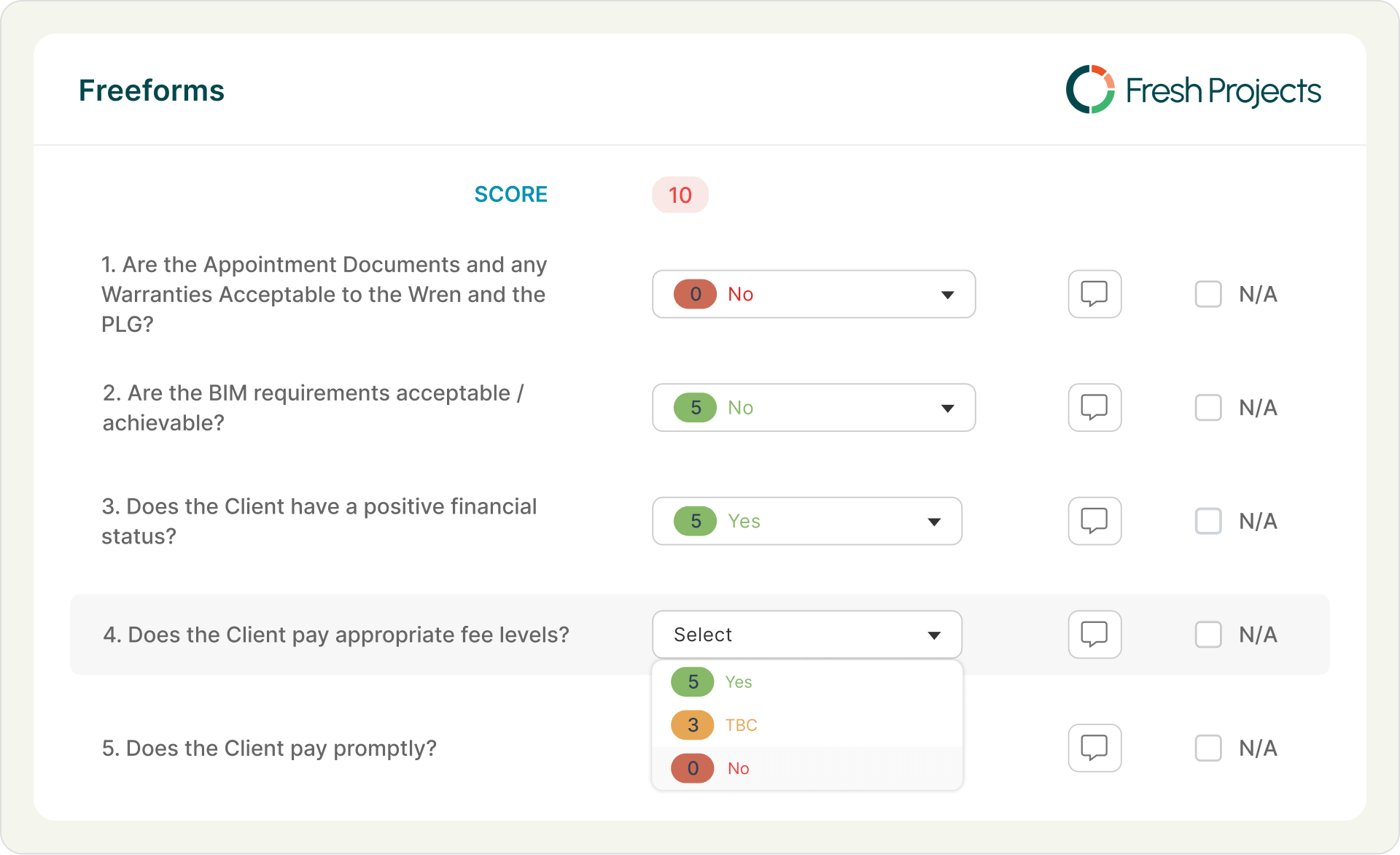
Image reference: Fresh Projects Freeforms
For example, an engineering firm specialising in public infrastructure declined to pursue a large commercial development after identifying a poor strategic fit. Instead, it focused on public sector opportunities where its win rate and margins were consistently stronger.
Use weighted forecasting to plan ahead
Weighted forecasting allows firms to move from reactive decision-making to informed planning.
Rather than assuming all leads will convert, weighted forecasting assigns probabilities to each opportunity and models likely future income.
How weighted forecasting works
Assign probabilities to leads
Estimate the likelihood of winning each opportunity based on experience and context.Forecast income and costs
Multiply potential fees by probability to create a realistic view of future revenue.Plan resources with confidence
Use forecasts to inform hiring, workload allocation and investment decisions.
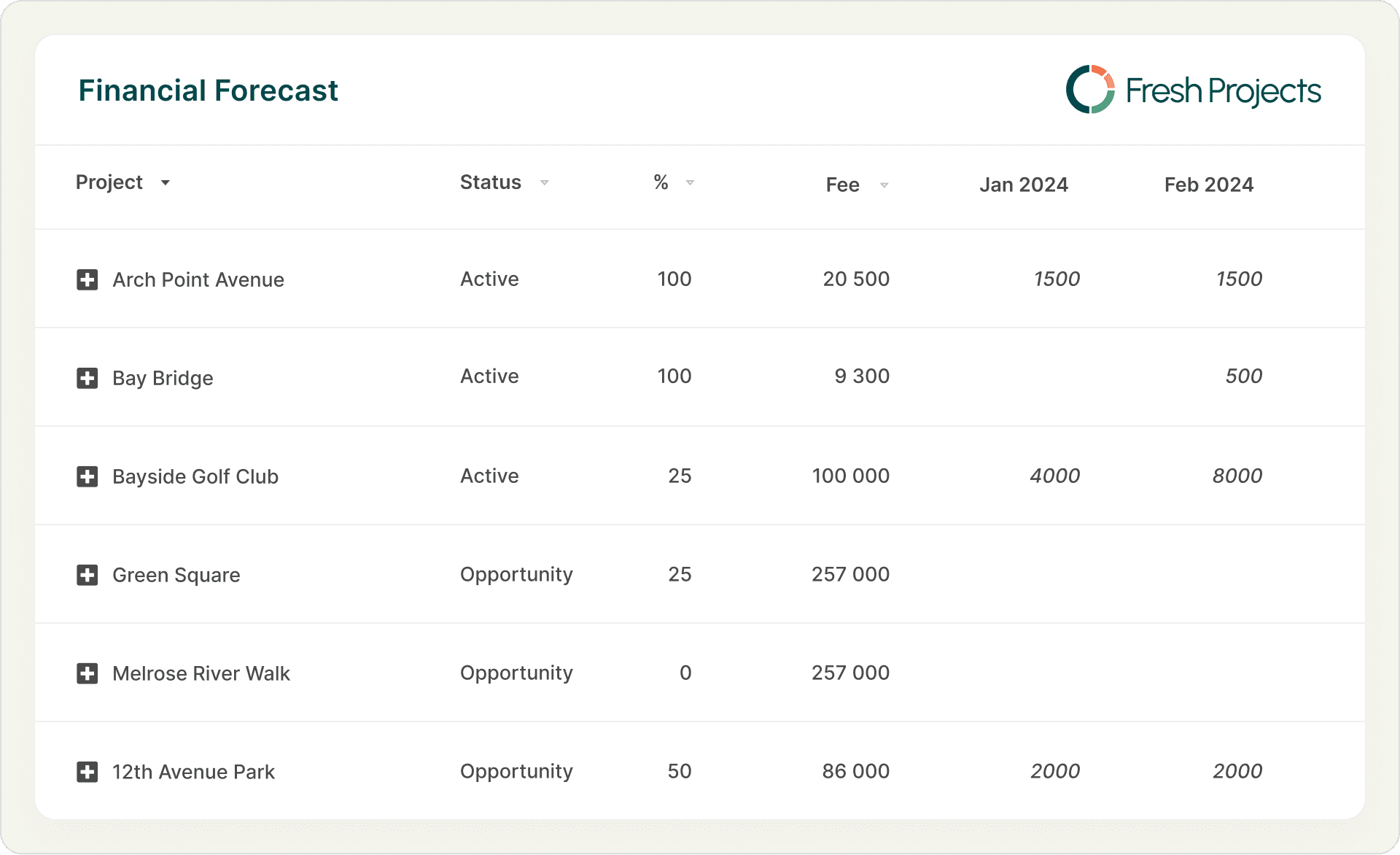
Image reference: Fresh Projects Forecast
For example, a construction firm assigned an 80 percent probability to a public sector project and a 50 percent probability to a smaller residential job. Using weighted forecasting, the firm adjusted staffing plans to avoid over-hiring while remaining ready to deliver both projects if secured.
Build a pipeline that supports profitability
When pipeline management, lead qualification and forecasting work together, firms gain control over growth.
Instead of reacting to workload spikes or shortages, leaders can make measured decisions about which work to pursue, when to hire and where to focus business development effort.
This approach reduces stress on teams, improves delivery consistency and protects margins.
Conclusion: your blueprint for profitable projects
Winning the right projects is fundamental to long-term profitability in AEC firms.
By actively managing your pipeline, qualifying leads rigorously and using weighted forecasting, you can focus on work that aligns with your strengths and financial goals.
Together with disciplined fee setting and cash flow management, these principles form a practical framework for sustainable success.
If you missed the earlier articles in the series, you can revisit:
Together, these insights provide a clear roadmap for improving financial performance across your practice.
Profitable Projects: A Three-Part Series on AEC Profitability
Welcome to the final instalment of Profitable Projects, a three-part series designed to help Architecture, Engineering and Construction firms improve long-term financial performance.
Across the series, we have explored three fundamentals of AEC profitability:
Winning the Right Projects (you are here)
In this final chapter, we focus on how selecting the right projects and the right clients underpins everything else. Even strong fee setting and cash flow discipline struggle to compensate for a pipeline full of the wrong work.
Why winning the right projects matters
Securing work is essential. Securing the right work is what sustains profitability.
Too many AEC firms fall into the trap of pursuing every opportunity that comes through the door. This spreads resources thin, increases bid costs and often leads to projects that are difficult to deliver profitably.
Winning the right projects means aligning opportunities with your firm’s expertise, capacity and commercial goals.
Manage your pipeline with intent
A healthy pipeline does not happen by accident. It requires active management and clear prioritisation.
Segment and categorise leads
Basic pipeline management starts with maintaining a list of leads and opportunities. To improve profitability, firms need to go further and categorise opportunities by:
Sector
Client type
Project size and complexity
This segmentation makes it easier to focus effort on opportunities that align with your firm’s strengths and historical performance.
For example, a mid-sized architecture firm specialising in high-end residential work segmented its pipeline by client type and project complexity. By focusing on projects with higher margins and better fit, the firm reduced bid effort while increasing overall profitability.
Qualify leads before committing resources
Lead qualification is one of the most powerful levers for improving profitability.
Not every opportunity is worth pursuing. Chasing low-probability or poorly aligned projects consumes time, increases risk and distracts teams from higher value work.
Key criteria for qualifying leads
Leads should be assessed against four core criteria:
Capability
Does the project align with your firm’s technical expertise and delivery experience?
Profit potential
Will the proposed fee realistically cover delivery costs, risks and potential scope change?
Likelihood of success
What is your historical win rate for similar projects, sectors or clients?
Client history
Does the client have a record of timely payment, clear decision-making and controlled scope?
Here is how some firms operationalise qualification using Fresh Projects.
Image reference: Fresh Projects Freeforms
For example, an engineering firm specialising in public infrastructure declined to pursue a large commercial development after identifying a poor strategic fit. Instead, it focused on public sector opportunities where its win rate and margins were consistently stronger.
Use weighted forecasting to plan ahead
Weighted forecasting allows firms to move from reactive decision-making to informed planning.
Rather than assuming all leads will convert, weighted forecasting assigns probabilities to each opportunity and models likely future income.
How weighted forecasting works
Assign probabilities to leads
Estimate the likelihood of winning each opportunity based on experience and context.Forecast income and costs
Multiply potential fees by probability to create a realistic view of future revenue.Plan resources with confidence
Use forecasts to inform hiring, workload allocation and investment decisions.
Image reference: Fresh Projects Forecast
For example, a construction firm assigned an 80 percent probability to a public sector project and a 50 percent probability to a smaller residential job. Using weighted forecasting, the firm adjusted staffing plans to avoid over-hiring while remaining ready to deliver both projects if secured.
Build a pipeline that supports profitability
When pipeline management, lead qualification and forecasting work together, firms gain control over growth.
Instead of reacting to workload spikes or shortages, leaders can make measured decisions about which work to pursue, when to hire and where to focus business development effort.
This approach reduces stress on teams, improves delivery consistency and protects margins.
Conclusion: your blueprint for profitable projects
Winning the right projects is fundamental to long-term profitability in AEC firms.
By actively managing your pipeline, qualifying leads rigorously and using weighted forecasting, you can focus on work that aligns with your strengths and financial goals.
Together with disciplined fee setting and cash flow management, these principles form a practical framework for sustainable success.
If you missed the earlier articles in the series, you can revisit:
Together, these insights provide a clear roadmap for improving financial performance across your practice.
Published:
Published:


Why Reporting Still Leaves Architecture and Engineering Firms Guessing
Why Reporting Still Leaves Architecture and Engineering Firms Guessing
Why Reporting Still Leaves Architecture and Engineering Firms Guessing
Inside many built environment firms, meetings meant for decisions quietly turn into debates about the numbers on the page.
Inside many built environment firms, meetings meant for decisions quietly turn into debates about the numbers on the page.
Read More
Read More

If One Office Says “That’s Not How We Do It”, Leadership is Flying Blind
If One Office Says “That’s Not How We Do It”, Leadership is Flying Blind
If One Office Says “That’s Not How We Do It”, Leadership is Flying Blind
In many built environment consultancies, reporting technically works. The challenge is that clarity often arrives after the moment when it would have influenced action.
In many built environment consultancies, reporting technically works. The challenge is that clarity often arrives after the moment when it would have influenced action.
Read More
Read More

Why Reporting Still Slows Down Established Firms Delivering Services in the Built Environment
Why Reporting Still Slows Down Established Firms Delivering Services in the Built Environment
Why Reporting Still Slows Down Established Firms Delivering Services in the Built Environment
Even with reporting systems in place, many architecture, engineering and quantity surveying firms find that insight arrives too late to influence decisions during delivery.
Even with reporting systems in place, many architecture, engineering and quantity surveying firms find that insight arrives too late to influence decisions during delivery.
Read More
Read More

How to Compare Practice Management Tools for Architect and Engineering Firms in 2026
How to Compare Practice Management Tools for Architect and Engineering Firms in 2026
How to Compare Practice Management Tools for Architect and Engineering Firms in 2026
Choosing a practice management system is no longer about feature lists. This guide explains how architecture and engineering firms should compare tools in 2026, focusing on adoption, usability and decision-making rather than complexity.
Choosing a practice management system is no longer about feature lists. This guide explains how architecture and engineering firms should compare tools in 2026, focusing on adoption, usability and decision-making rather than complexity.
Read More
Read More

Autumn Budget 2025: What It Means for Architecture and Engineering Firms
Autumn Budget 2025: What It Means for Architecture and Engineering Firms
Autumn Budget 2025: What It Means for Architecture and Engineering Firms
Implications for resourcing, margins and medium-term planning
Implications for resourcing, margins and medium-term planning
Read More
Read More

How Larger Architecture and Engineering Firms Stay Profitable in a Slower Construction Market
How Larger Architecture and Engineering Firms Stay Profitable in a Slower Construction Market
How Larger Architecture and Engineering Firms Stay Profitable in a Slower Construction Market
What 50–100 person practices are tightening up when pipelines soften
What 50–100 person practices are tightening up when pipelines soften
Read More
Read More

Why Traditional Reporting is Holding A&E Firms Back
Why Traditional Reporting is Holding A&E Firms Back
Why Traditional Reporting is Holding A&E Firms Back
Why Traditional Reporting is Holding A&E Firms Back
Why Traditional Reporting is Holding A&E Firms Back
Read More
Read More

Spreadsheets in A&E Firms: Usage, Key Features, and Underappreciated Gems
Spreadsheets in A&E Firms: Usage, Key Features, and Underappreciated Gems
Spreadsheets in A&E Firms: Usage, Key Features, and Underappreciated Gems
A practical guide to using Excel and Sheets well, and knowing when to graduate to purpose-built systems without losing the flexibility you love.
A practical guide to using Excel and Sheets well, and knowing when to graduate to purpose-built systems without losing the flexibility you love.
Read More
Read More

Breaking Barriers in AEC: Meet the Women Driving Fresh Projects
Breaking Barriers in AEC: Meet the Women Driving Fresh Projects
Breaking Barriers in AEC: Meet the Women Driving Fresh Projects
Why representation, visibility and better systems matter for the future of architecture and engineering
Why representation, visibility and better systems matter for the future of architecture and engineering
Read More
Read More

Legacy Firms, Future Focus: Why Architecture’s Crossroads Is a Leadership Moment
Legacy Firms, Future Focus: Why Architecture’s Crossroads Is a Leadership Moment
Legacy Firms, Future Focus: Why Architecture’s Crossroads Is a Leadership Moment
How firm leaders can protect margin, prepare successors and modernise delivery without losing what made them successful
How firm leaders can protect margin, prepare successors and modernise delivery without losing what made them successful
Read More
Read More

Outgrowing Spreadsheets: 5 Ways to Maintain Profitability as Your Firm Grows
Outgrowing Spreadsheets: 5 Ways to Maintain Profitability as Your Firm Grows
Outgrowing Spreadsheets: 5 Ways to Maintain Profitability as Your Firm Grows
How architecture and engineering practices protect margin as teams and project complexity increase
How architecture and engineering practices protect margin as teams and project complexity increase
Read More
Read More

The Profitability Pyramid: Where UK Architecture Firms Make and Lose Money
The Profitability Pyramid: Where UK Architecture Firms Make and Lose Money
The Profitability Pyramid: Where UK Architecture Firms Make and Lose Money
Understanding the real drivers of financial performance for medium and large practices over the past year
Understanding the real drivers of financial performance for medium and large practices over the past year
Read More
Read More

3 Lessons to Help You Run a More Profitable Practice
3 Lessons to Help You Run a More Profitable Practice
3 Lessons to Help You Run a More Profitable Practice
Practical insights from A&E leaders on spotting profit risks early, communicating value, and protecting margins
Practical insights from A&E leaders on spotting profit risks early, communicating value, and protecting margins
Read More
Read More

Embracing Neurodiversity in Architecture
Embracing Neurodiversity in Architecture
Embracing Neurodiversity in Architecture
How inclusive practice design can unlock creativity, innovation and operational clarity
How inclusive practice design can unlock creativity, innovation and operational clarity
Read More
Read More
Profitable Projects: Winning the Right Projects in AEC
Profitable Projects: Winning the Right Projects in AEC
Profitable Projects: Winning the Right Projects in AEC
How to qualify leads, focus your pipeline and forecast success more confidently
How to qualify leads, focus your pipeline and forecast success more confidently
Read More
Read More

Profitable Projects: The Art of Cashflow Alchemy in AEC
Profitable Projects: The Art of Cashflow Alchemy in AEC
Profitable Projects: The Art of Cashflow Alchemy in AEC
How architecture and engineering firms can turn unpredictable cash flow into a strategic advantage
How architecture and engineering firms can turn unpredictable cash flow into a strategic advantage
Read More
Read More

Profitable Projects: A Three-Part Series on AEC Profitability - Setting the Right Fee for Success
Profitable Projects: A Three-Part Series on AEC Profitability - Setting the Right Fee for Success
Profitable Projects: A Three-Part Series on AEC Profitability - Setting the Right Fee for Success
Why bottom-up fee setting, clear scope and real-time cost visibility underpin profitable projects
Why bottom-up fee setting, clear scope and real-time cost visibility underpin profitable projects
Read More
Read More

How Firm Management Tools for Architects and Engineers Drastically Increase Profits
How Firm Management Tools for Architects and Engineers Drastically Increase Profits
How Firm Management Tools for Architects and Engineers Drastically Increase Profits
Why better visibility across projects, people and finances is now essential for sustainable practice performance
Why better visibility across projects, people and finances is now essential for sustainable practice performance
Read More
Read More

How to Manage Inflation on Architecture Projects
How to Manage Inflation on Architecture Projects
How to Manage Inflation on Architecture Projects
Practical ways to protect fees and margins when costs change mid-project
Practical ways to protect fees and margins when costs change mid-project
Read More
Read More

An Architect’s Guide to Project Budgeting
An Architect’s Guide to Project Budgeting
An Architect’s Guide to Project Budgeting
How to build realistic, profitable project budgets that support better pricing and delivery
How to build realistic, profitable project budgets that support better pricing and delivery
Read More
Read More

An Architect’s Guide to Managing Scope Creep
An Architect’s Guide to Managing Scope Creep
An Architect’s Guide to Managing Scope Creep
How to protect fees, margins and client relationships when projects change
How to protect fees, margins and client relationships when projects change
Read More
Read More

Improve Project Profitability: An Architect’s Guide
Improve Project Profitability: An Architect’s Guide
Improve Project Profitability: An Architect’s Guide
Practical ways architecture practices can protect margins and make better commercial decisions
Practical ways architecture practices can protect margins and make better commercial decisions
Read More
Read More

Pricing Methods for Architects: How to Price Architecture Services
Pricing Methods for Architects: How to Price Architecture Services
Pricing Methods for Architects: How to Price Architecture Services
When to use hourly rates, fixed fees or percentage pricing, and how to choose with confidence
When to use hourly rates, fixed fees or percentage pricing, and how to choose with confidence
Read More
Read More

Calculate Your Cost Rate in 3 Simple Steps
Calculate Your Cost Rate in 3 Simple Steps
Calculate Your Cost Rate in 3 Simple Steps
Why understanding your true cost rate is the foundation of profitable fees, resourcing and decision-making
Why understanding your true cost rate is the foundation of profitable fees, resourcing and decision-making
Read More
Read More

When to Hire? Three Factors That Will Change How You Think About Resourcing
When to Hire? Three Factors That Will Change How You Think About Resourcing
When to Hire? Three Factors That Will Change How You Think About Resourcing
Why workload visibility and forecasting matter more than instinct in mid-sized architecture practices
Why workload visibility and forecasting matter more than instinct in mid-sized architecture practices
Read More
Read More

Didn’t Reach Your Profit Goals Last Year? Get These 5 Basics Right This Year
Didn’t Reach Your Profit Goals Last Year? Get These 5 Basics Right This Year
Didn’t Reach Your Profit Goals Last Year? Get These 5 Basics Right This Year
Five practical habits that help architecture practices improve profitability without adding complexity
Five practical habits that help architecture practices improve profitability without adding complexity
Read More
Read More

3 Questions Every Profitable Architecture Practice Can Answer
3 Questions Every Profitable Architecture Practice Can Answer
3 Questions Every Profitable Architecture Practice Can Answer
How clear insight into projects, clients and utilisation drives better decisions in mid-sized A&E firms
How clear insight into projects, clients and utilisation drives better decisions in mid-sized A&E firms
Read More
Read More

Is There a Secret to Being a Profitable Architecture Practice?
Is There a Secret to Being a Profitable Architecture Practice?
Is There a Secret to Being a Profitable Architecture Practice?
Why the most profitable firms spend less time on financial management and still make better decisions
Why the most profitable firms spend less time on financial management and still make better decisions
Read More
Read More

The “A Team” Approach: How a Simple Change Can Improve Profitability
The “A Team” Approach: How a Simple Change Can Improve Profitability
The “A Team” Approach: How a Simple Change Can Improve Profitability
Why reallocating work across roles can dramatically improve utilisation and margins in 50–100 person A&E practices
Why reallocating work across roles can dramatically improve utilisation and margins in 50–100 person A&E practices
Read More
Read More

I Love Excel. I Hate Excel.
I Love Excel. I Hate Excel.
I Love Excel. I Hate Excel.
Why spreadsheets break down in 50–100 person architecture and engineering practices, and what works better
Why spreadsheets break down in 50–100 person architecture and engineering practices, and what works better
Read More
Read More

Getting Project Fees Right in Large Architecture and Engineering Firms
Getting Project Fees Right in Large Architecture and Engineering Firms
Getting Project Fees Right in Large Architecture and Engineering Firms
How accurate budgeting and disciplined scope control protect profitability in 50–100 person A&E practices
How accurate budgeting and disciplined scope control protect profitability in 50–100 person A&E practices
Read More
Read More

Why Hidden Working Capital Is the Silent Risk in Large Architecture and Engineering Firms
Why Hidden Working Capital Is the Silent Risk in Large Architecture and Engineering Firms
Why Hidden Working Capital Is the Silent Risk in Large Architecture and Engineering Firms
The financial blind spot that catches even well-run architecture and engineering practices
The financial blind spot that catches even well-run architecture and engineering practices
Read More
Read More

How Large Architecture and Engineering Firms Win More of the Right Jobs
How Large Architecture and Engineering Firms Win More of the Right Jobs
How Large Architecture and Engineering Firms Win More of the Right Jobs
How Large Architecture and Engineering Firms Win More of the Right Jobs
How Large Architecture and Engineering Firms Win More of the Right Jobs
Read More
Read More
Fresh Projects is a UK-based software platform designed for architects, engineers, and other built-environment professionals to manage financial aspects of their projects. It helps teams track fees, timesheets, expenses, billing, and overall profitability to keep projects on budget and profitable. The platform also centralises project data, streamlines administrative tasks, and offers mobile app support for easy access and updates.
1a Colinette Road
London
SW15 6QG
© 2026 Fresh Projects
Product
