
Fresh Projects is a UK-based software platform designed for architects, engineers, and other built-environment professionals to manage financial aspects of their projects. It helps teams track fees, timesheets, expenses, billing, and overall profitability to keep projects on budget and profitable. The platform also centralises project data, streamlines administrative tasks, and offers mobile app support for easy access and updates.
1a Colinette Road
London
SW15 6QG
© 2026 Fresh Projects
Product
Fresh Projects is a UK-based software platform designed for architects, engineers, and other built-environment professionals to manage financial aspects of their projects. It helps teams track fees, timesheets, expenses, billing, and overall profitability to keep projects on budget and profitable. The platform also centralises project data, streamlines administrative tasks, and offers mobile app support for easy access and updates.
1a Colinette Road
London
SW15 6QG
© 2026 Fresh Projects
Product
How Larger Architecture and Engineering Firms Stay Profitable in a Slower Construction Market
How Larger Architecture and Engineering Firms Stay Profitable in a Slower Construction Market
How Larger Architecture and Engineering Firms Stay Profitable in a Slower Construction Market
Reading Time:
Reading Time:
5
5
minute(s)
minute(s)

Construction employment in the UK has fallen to its lowest level in more than two decades. Fewer projects are progressing to site and investment across housing, commercial and infrastructure work has slowed.
This decline is not a sign of a shortage of architecture or engineering professionals. It reflects fewer projects moving through delivery and a reduction in construction investment overall. When delivery slows, confidence falls, pipelines become harder to predict and competition increases for the projects that do move forward.
For larger architecture and engineering firms, a slower construction market rarely creates new problems. Instead, it amplifies the ones that already exist.
Boards still need reliable information to steer the firm.
Different offices and disciplines still need to report in a consistent way.
Margins still need to be protected, often more carefully than before.
What changes is the tolerance for inconsistency. When the market tightens, fragmented data, unclear reporting and reactive decision-making become expensive very quickly.
What the long-term data tells us about the slowdown
The long-term picture reinforces this slowdown. As shown below, total construction employment has been decreasing for more than a decade. After previous peaks in 2008 and 2019, the workforce has continued to shrink, falling to just over 2.05 million people in Q3 2025.
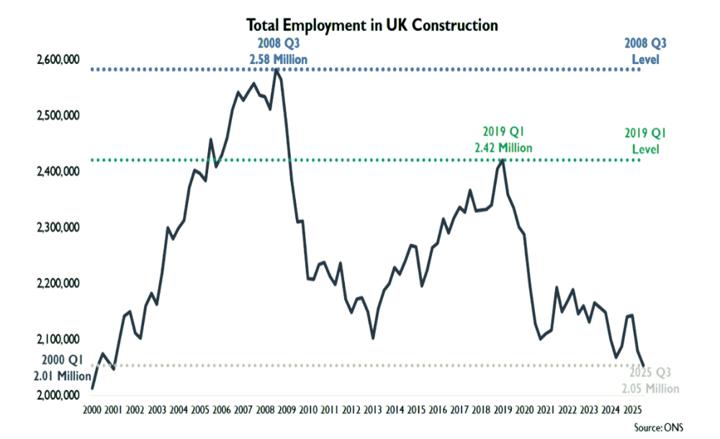
This reduction is not caused by a shortage of architects or engineers. It mirrors the lower level of work progressing to site, particularly in housing and commercial development.
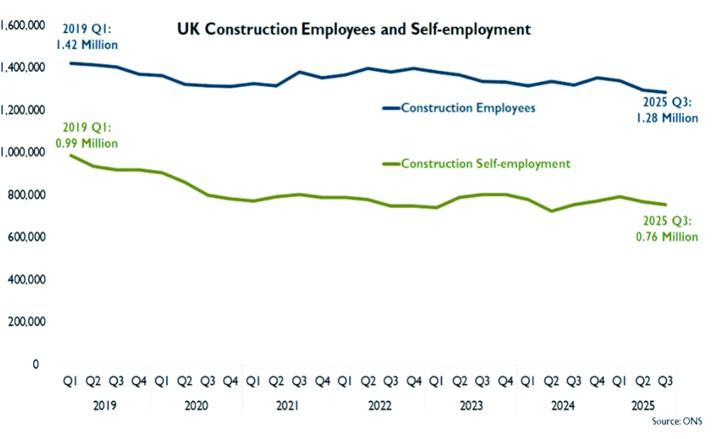
The decline is visible across the two main parts of the workforce. Employee numbers within construction have fallen by around 140,000 since 2019, while self-employment has dropped by almost a quarter of a million. These shifts reflect reduced sector activity rather than a lack of professional design staff. They underline a quieter market overall, where fewer projects are being delivered and confidence has weakened.
In this context, the firms that remain steady are the ones that bring more structure to how they operate. They rely on clear data, consistent processes and shared understanding across teams, rather than pushing harder and hoping for the best.
Here are five practical ways larger practices are strengthening resilience in a slower market
1. Creating consistent reporting across all offices and teams
In slower markets, directors need a clear and dependable view of performance. This becomes difficult when one office relies on spreadsheets, another uses legacy tools and teams calculate key metrics in different ways.
Larger practices are addressing this by agreeing a single definition of core measures such as profitability, utilisation, earned value, pipeline and forecast. Once those definitions are aligned, reporting becomes faster and more credible at board level.
The firms that make this work keep systems simple enough for every team to adopt. Consistency, not complexity, is what improves confidence in the numbers.
Action tip:
Run a quarterly alignment session with finance and operations. Review how each team calculates the same five core metrics. Agree one definition for each, document it clearly and embed it into weekly and monthly reporting. This small governance step improves accuracy across the entire practice.
2. Prioritising the right projects to protect margins
When the market slows, the temptation is to win more work. The risk is filling the pipeline with small or low-margin projects that keep teams busy without strengthening the business.
More resilient firms are becoming selective. They assess opportunities based on margin potential, client behaviour and delivery complexity, not just workload. Projects that fall below threshold prompt a rethink on scope, pricing or resourcing rather than being accepted automatically.
Action tip:
Introduce a simple scoring model for new bids. Assess likely margin, strategic value and delivery risk. If a project scores poorly, use that as a trigger to adjust terms or decline the opportunity altogether.
3. Building a weekly operational rhythm
Monthly reporting often arrives too late to influence outcomes. In quieter markets, firms benefit from shorter feedback loops.
A brief weekly review that looks at utilisation, current project risks and upcoming resourcing allows teams to spot drift early. It also improves communication between offices and disciplines when pressure increases.
Action tip:
Hold a 15-minute weekly review with a fixed agenda. Focus on current utilisation, the top project risks and the next two weeks of resourcing. Keep it short, practical and action-oriented.
4. Simplifying workflows to free capacity
As delivery slows, inefficiencies become more visible. Many larger practices still carry manual processes designed for much smaller teams, including duplicated data entry and spreadsheet reconciliation.
Firms are starting by simplifying what already exists. Standardised templates, fewer approval layers and clearer handovers often release meaningful time without introducing new systems.
Action tip:
Ask each office to identify the three administrative tasks that consume the most time. Choose one to simplify each quarter. Over a year, the cumulative impact across 50 to 100 staff is significant.
5. Making visibility a shared habit, not just a report
The most resilient firms treat visibility as part of how they operate, not something owned by finance alone.
Project leads engage with live data regularly. Teams understand how their decisions affect margin and resourcing. Issues are surfaced early and addressed while there is still room to act.
Action tip:
Encourage project teams to review their performance data together each week. Ask three simple questions: what went well, what is at risk, and what needs to change. This builds shared awareness without adding admin.
The bottom line
The fall in construction employment reflects a quieter market, not a shortage of design professionals. For larger architecture and engineering firms, the priority is maintaining clarity, consistency and confidence when pipelines are less predictable.
Firms that standardise reporting, focus on profitable work, simplify internal processes and build strong operational habits are better placed to remain stable and competitive.
In slower markets, discipline outperforms urgency.
Construction employment in the UK has fallen to its lowest level in more than two decades. Fewer projects are progressing to site and investment across housing, commercial and infrastructure work has slowed.
This decline is not a sign of a shortage of architecture or engineering professionals. It reflects fewer projects moving through delivery and a reduction in construction investment overall. When delivery slows, confidence falls, pipelines become harder to predict and competition increases for the projects that do move forward.
For larger architecture and engineering firms, a slower construction market rarely creates new problems. Instead, it amplifies the ones that already exist.
Boards still need reliable information to steer the firm.
Different offices and disciplines still need to report in a consistent way.
Margins still need to be protected, often more carefully than before.
What changes is the tolerance for inconsistency. When the market tightens, fragmented data, unclear reporting and reactive decision-making become expensive very quickly.
What the long-term data tells us about the slowdown
The long-term picture reinforces this slowdown. As shown below, total construction employment has been decreasing for more than a decade. After previous peaks in 2008 and 2019, the workforce has continued to shrink, falling to just over 2.05 million people in Q3 2025.
This reduction is not caused by a shortage of architects or engineers. It mirrors the lower level of work progressing to site, particularly in housing and commercial development.
The decline is visible across the two main parts of the workforce. Employee numbers within construction have fallen by around 140,000 since 2019, while self-employment has dropped by almost a quarter of a million. These shifts reflect reduced sector activity rather than a lack of professional design staff. They underline a quieter market overall, where fewer projects are being delivered and confidence has weakened.
In this context, the firms that remain steady are the ones that bring more structure to how they operate. They rely on clear data, consistent processes and shared understanding across teams, rather than pushing harder and hoping for the best.
Here are five practical ways larger practices are strengthening resilience in a slower market
1. Creating consistent reporting across all offices and teams
In slower markets, directors need a clear and dependable view of performance. This becomes difficult when one office relies on spreadsheets, another uses legacy tools and teams calculate key metrics in different ways.
Larger practices are addressing this by agreeing a single definition of core measures such as profitability, utilisation, earned value, pipeline and forecast. Once those definitions are aligned, reporting becomes faster and more credible at board level.
The firms that make this work keep systems simple enough for every team to adopt. Consistency, not complexity, is what improves confidence in the numbers.
Action tip:
Run a quarterly alignment session with finance and operations. Review how each team calculates the same five core metrics. Agree one definition for each, document it clearly and embed it into weekly and monthly reporting. This small governance step improves accuracy across the entire practice.
2. Prioritising the right projects to protect margins
When the market slows, the temptation is to win more work. The risk is filling the pipeline with small or low-margin projects that keep teams busy without strengthening the business.
More resilient firms are becoming selective. They assess opportunities based on margin potential, client behaviour and delivery complexity, not just workload. Projects that fall below threshold prompt a rethink on scope, pricing or resourcing rather than being accepted automatically.
Action tip:
Introduce a simple scoring model for new bids. Assess likely margin, strategic value and delivery risk. If a project scores poorly, use that as a trigger to adjust terms or decline the opportunity altogether.
3. Building a weekly operational rhythm
Monthly reporting often arrives too late to influence outcomes. In quieter markets, firms benefit from shorter feedback loops.
A brief weekly review that looks at utilisation, current project risks and upcoming resourcing allows teams to spot drift early. It also improves communication between offices and disciplines when pressure increases.
Action tip:
Hold a 15-minute weekly review with a fixed agenda. Focus on current utilisation, the top project risks and the next two weeks of resourcing. Keep it short, practical and action-oriented.
4. Simplifying workflows to free capacity
As delivery slows, inefficiencies become more visible. Many larger practices still carry manual processes designed for much smaller teams, including duplicated data entry and spreadsheet reconciliation.
Firms are starting by simplifying what already exists. Standardised templates, fewer approval layers and clearer handovers often release meaningful time without introducing new systems.
Action tip:
Ask each office to identify the three administrative tasks that consume the most time. Choose one to simplify each quarter. Over a year, the cumulative impact across 50 to 100 staff is significant.
5. Making visibility a shared habit, not just a report
The most resilient firms treat visibility as part of how they operate, not something owned by finance alone.
Project leads engage with live data regularly. Teams understand how their decisions affect margin and resourcing. Issues are surfaced early and addressed while there is still room to act.
Action tip:
Encourage project teams to review their performance data together each week. Ask three simple questions: what went well, what is at risk, and what needs to change. This builds shared awareness without adding admin.
The bottom line
The fall in construction employment reflects a quieter market, not a shortage of design professionals. For larger architecture and engineering firms, the priority is maintaining clarity, consistency and confidence when pipelines are less predictable.
Firms that standardise reporting, focus on profitable work, simplify internal processes and build strong operational habits are better placed to remain stable and competitive.
In slower markets, discipline outperforms urgency.
Published:
Published:


Why Reporting Still Leaves Architecture and Engineering Firms Guessing
Why Reporting Still Leaves Architecture and Engineering Firms Guessing
Why Reporting Still Leaves Architecture and Engineering Firms Guessing
Inside many built environment firms, meetings meant for decisions quietly turn into debates about the numbers on the page.
Inside many built environment firms, meetings meant for decisions quietly turn into debates about the numbers on the page.
Read More
Read More

If One Office Says “That’s Not How We Do It”, Leadership is Flying Blind
If One Office Says “That’s Not How We Do It”, Leadership is Flying Blind
If One Office Says “That’s Not How We Do It”, Leadership is Flying Blind
In many built environment consultancies, reporting technically works. The challenge is that clarity often arrives after the moment when it would have influenced action.
In many built environment consultancies, reporting technically works. The challenge is that clarity often arrives after the moment when it would have influenced action.
Read More
Read More

Why Reporting Still Slows Down Established Firms Delivering Services in the Built Environment
Why Reporting Still Slows Down Established Firms Delivering Services in the Built Environment
Why Reporting Still Slows Down Established Firms Delivering Services in the Built Environment
Even with reporting systems in place, many architecture, engineering and quantity surveying firms find that insight arrives too late to influence decisions during delivery.
Even with reporting systems in place, many architecture, engineering and quantity surveying firms find that insight arrives too late to influence decisions during delivery.
Read More
Read More

How to Compare Practice Management Tools for Architect and Engineering Firms in 2026
How to Compare Practice Management Tools for Architect and Engineering Firms in 2026
How to Compare Practice Management Tools for Architect and Engineering Firms in 2026
Choosing a practice management system is no longer about feature lists. This guide explains how architecture and engineering firms should compare tools in 2026, focusing on adoption, usability and decision-making rather than complexity.
Choosing a practice management system is no longer about feature lists. This guide explains how architecture and engineering firms should compare tools in 2026, focusing on adoption, usability and decision-making rather than complexity.
Read More
Read More

Autumn Budget 2025: What It Means for Architecture and Engineering Firms
Autumn Budget 2025: What It Means for Architecture and Engineering Firms
Autumn Budget 2025: What It Means for Architecture and Engineering Firms
Implications for resourcing, margins and medium-term planning
Implications for resourcing, margins and medium-term planning
Read More
Read More
How Larger Architecture and Engineering Firms Stay Profitable in a Slower Construction Market
How Larger Architecture and Engineering Firms Stay Profitable in a Slower Construction Market
How Larger Architecture and Engineering Firms Stay Profitable in a Slower Construction Market
What 50–100 person practices are tightening up when pipelines soften
What 50–100 person practices are tightening up when pipelines soften
Read More
Read More

Why Traditional Reporting is Holding A&E Firms Back
Why Traditional Reporting is Holding A&E Firms Back
Why Traditional Reporting is Holding A&E Firms Back
Why Traditional Reporting is Holding A&E Firms Back
Why Traditional Reporting is Holding A&E Firms Back
Read More
Read More

Spreadsheets in A&E Firms: Usage, Key Features, and Underappreciated Gems
Spreadsheets in A&E Firms: Usage, Key Features, and Underappreciated Gems
Spreadsheets in A&E Firms: Usage, Key Features, and Underappreciated Gems
A practical guide to using Excel and Sheets well, and knowing when to graduate to purpose-built systems without losing the flexibility you love.
A practical guide to using Excel and Sheets well, and knowing when to graduate to purpose-built systems without losing the flexibility you love.
Read More
Read More

Breaking Barriers in AEC: Meet the Women Driving Fresh Projects
Breaking Barriers in AEC: Meet the Women Driving Fresh Projects
Breaking Barriers in AEC: Meet the Women Driving Fresh Projects
Why representation, visibility and better systems matter for the future of architecture and engineering
Why representation, visibility and better systems matter for the future of architecture and engineering
Read More
Read More

Legacy Firms, Future Focus: Why Architecture’s Crossroads Is a Leadership Moment
Legacy Firms, Future Focus: Why Architecture’s Crossroads Is a Leadership Moment
Legacy Firms, Future Focus: Why Architecture’s Crossroads Is a Leadership Moment
How firm leaders can protect margin, prepare successors and modernise delivery without losing what made them successful
How firm leaders can protect margin, prepare successors and modernise delivery without losing what made them successful
Read More
Read More

Outgrowing Spreadsheets: 5 Ways to Maintain Profitability as Your Firm Grows
Outgrowing Spreadsheets: 5 Ways to Maintain Profitability as Your Firm Grows
Outgrowing Spreadsheets: 5 Ways to Maintain Profitability as Your Firm Grows
How architecture and engineering practices protect margin as teams and project complexity increase
How architecture and engineering practices protect margin as teams and project complexity increase
Read More
Read More

The Profitability Pyramid: Where UK Architecture Firms Make and Lose Money
The Profitability Pyramid: Where UK Architecture Firms Make and Lose Money
The Profitability Pyramid: Where UK Architecture Firms Make and Lose Money
Understanding the real drivers of financial performance for medium and large practices over the past year
Understanding the real drivers of financial performance for medium and large practices over the past year
Read More
Read More

3 Lessons to Help You Run a More Profitable Practice
3 Lessons to Help You Run a More Profitable Practice
3 Lessons to Help You Run a More Profitable Practice
Practical insights from A&E leaders on spotting profit risks early, communicating value, and protecting margins
Practical insights from A&E leaders on spotting profit risks early, communicating value, and protecting margins
Read More
Read More

Embracing Neurodiversity in Architecture
Embracing Neurodiversity in Architecture
Embracing Neurodiversity in Architecture
How inclusive practice design can unlock creativity, innovation and operational clarity
How inclusive practice design can unlock creativity, innovation and operational clarity
Read More
Read More

Profitable Projects: Winning the Right Projects in AEC
Profitable Projects: Winning the Right Projects in AEC
Profitable Projects: Winning the Right Projects in AEC
How to qualify leads, focus your pipeline and forecast success more confidently
How to qualify leads, focus your pipeline and forecast success more confidently
Read More
Read More

Profitable Projects: The Art of Cashflow Alchemy in AEC
Profitable Projects: The Art of Cashflow Alchemy in AEC
Profitable Projects: The Art of Cashflow Alchemy in AEC
How architecture and engineering firms can turn unpredictable cash flow into a strategic advantage
How architecture and engineering firms can turn unpredictable cash flow into a strategic advantage
Read More
Read More

Profitable Projects: A Three-Part Series on AEC Profitability - Setting the Right Fee for Success
Profitable Projects: A Three-Part Series on AEC Profitability - Setting the Right Fee for Success
Profitable Projects: A Three-Part Series on AEC Profitability - Setting the Right Fee for Success
Why bottom-up fee setting, clear scope and real-time cost visibility underpin profitable projects
Why bottom-up fee setting, clear scope and real-time cost visibility underpin profitable projects
Read More
Read More

How Firm Management Tools for Architects and Engineers Drastically Increase Profits
How Firm Management Tools for Architects and Engineers Drastically Increase Profits
How Firm Management Tools for Architects and Engineers Drastically Increase Profits
Why better visibility across projects, people and finances is now essential for sustainable practice performance
Why better visibility across projects, people and finances is now essential for sustainable practice performance
Read More
Read More

How to Manage Inflation on Architecture Projects
How to Manage Inflation on Architecture Projects
How to Manage Inflation on Architecture Projects
Practical ways to protect fees and margins when costs change mid-project
Practical ways to protect fees and margins when costs change mid-project
Read More
Read More

An Architect’s Guide to Project Budgeting
An Architect’s Guide to Project Budgeting
An Architect’s Guide to Project Budgeting
How to build realistic, profitable project budgets that support better pricing and delivery
How to build realistic, profitable project budgets that support better pricing and delivery
Read More
Read More

An Architect’s Guide to Managing Scope Creep
An Architect’s Guide to Managing Scope Creep
An Architect’s Guide to Managing Scope Creep
How to protect fees, margins and client relationships when projects change
How to protect fees, margins and client relationships when projects change
Read More
Read More

Improve Project Profitability: An Architect’s Guide
Improve Project Profitability: An Architect’s Guide
Improve Project Profitability: An Architect’s Guide
Practical ways architecture practices can protect margins and make better commercial decisions
Practical ways architecture practices can protect margins and make better commercial decisions
Read More
Read More

Pricing Methods for Architects: How to Price Architecture Services
Pricing Methods for Architects: How to Price Architecture Services
Pricing Methods for Architects: How to Price Architecture Services
When to use hourly rates, fixed fees or percentage pricing, and how to choose with confidence
When to use hourly rates, fixed fees or percentage pricing, and how to choose with confidence
Read More
Read More

Calculate Your Cost Rate in 3 Simple Steps
Calculate Your Cost Rate in 3 Simple Steps
Calculate Your Cost Rate in 3 Simple Steps
Why understanding your true cost rate is the foundation of profitable fees, resourcing and decision-making
Why understanding your true cost rate is the foundation of profitable fees, resourcing and decision-making
Read More
Read More

When to Hire? Three Factors That Will Change How You Think About Resourcing
When to Hire? Three Factors That Will Change How You Think About Resourcing
When to Hire? Three Factors That Will Change How You Think About Resourcing
Why workload visibility and forecasting matter more than instinct in mid-sized architecture practices
Why workload visibility and forecasting matter more than instinct in mid-sized architecture practices
Read More
Read More

Didn’t Reach Your Profit Goals Last Year? Get These 5 Basics Right This Year
Didn’t Reach Your Profit Goals Last Year? Get These 5 Basics Right This Year
Didn’t Reach Your Profit Goals Last Year? Get These 5 Basics Right This Year
Five practical habits that help architecture practices improve profitability without adding complexity
Five practical habits that help architecture practices improve profitability without adding complexity
Read More
Read More

3 Questions Every Profitable Architecture Practice Can Answer
3 Questions Every Profitable Architecture Practice Can Answer
3 Questions Every Profitable Architecture Practice Can Answer
How clear insight into projects, clients and utilisation drives better decisions in mid-sized A&E firms
How clear insight into projects, clients and utilisation drives better decisions in mid-sized A&E firms
Read More
Read More

Is There a Secret to Being a Profitable Architecture Practice?
Is There a Secret to Being a Profitable Architecture Practice?
Is There a Secret to Being a Profitable Architecture Practice?
Why the most profitable firms spend less time on financial management and still make better decisions
Why the most profitable firms spend less time on financial management and still make better decisions
Read More
Read More

The “A Team” Approach: How a Simple Change Can Improve Profitability
The “A Team” Approach: How a Simple Change Can Improve Profitability
The “A Team” Approach: How a Simple Change Can Improve Profitability
Why reallocating work across roles can dramatically improve utilisation and margins in 50–100 person A&E practices
Why reallocating work across roles can dramatically improve utilisation and margins in 50–100 person A&E practices
Read More
Read More

I Love Excel. I Hate Excel.
I Love Excel. I Hate Excel.
I Love Excel. I Hate Excel.
Why spreadsheets break down in 50–100 person architecture and engineering practices, and what works better
Why spreadsheets break down in 50–100 person architecture and engineering practices, and what works better
Read More
Read More

Getting Project Fees Right in Large Architecture and Engineering Firms
Getting Project Fees Right in Large Architecture and Engineering Firms
Getting Project Fees Right in Large Architecture and Engineering Firms
How accurate budgeting and disciplined scope control protect profitability in 50–100 person A&E practices
How accurate budgeting and disciplined scope control protect profitability in 50–100 person A&E practices
Read More
Read More

Why Hidden Working Capital Is the Silent Risk in Large Architecture and Engineering Firms
Why Hidden Working Capital Is the Silent Risk in Large Architecture and Engineering Firms
Why Hidden Working Capital Is the Silent Risk in Large Architecture and Engineering Firms
The financial blind spot that catches even well-run architecture and engineering practices
The financial blind spot that catches even well-run architecture and engineering practices
Read More
Read More

How Large Architecture and Engineering Firms Win More of the Right Jobs
How Large Architecture and Engineering Firms Win More of the Right Jobs
How Large Architecture and Engineering Firms Win More of the Right Jobs
How Large Architecture and Engineering Firms Win More of the Right Jobs
How Large Architecture and Engineering Firms Win More of the Right Jobs
Read More
Read More
Fresh Projects is a UK-based software platform designed for architects, engineers, and other built-environment professionals to manage financial aspects of their projects. It helps teams track fees, timesheets, expenses, billing, and overall profitability to keep projects on budget and profitable. The platform also centralises project data, streamlines administrative tasks, and offers mobile app support for easy access and updates.
1a Colinette Road
London
SW15 6QG
© 2026 Fresh Projects
Product
