
Fresh Projects is a UK-based software platform designed for architects, engineers, and other built-environment professionals to manage financial aspects of their projects. It helps teams track fees, timesheets, expenses, billing, and overall profitability to keep projects on budget and profitable. The platform also centralises project data, streamlines administrative tasks, and offers mobile app support for easy access and updates.
1a Colinette Road
London
SW15 6QG
© 2026 Fresh Projects
Product
Fresh Projects is a UK-based software platform designed for architects, engineers, and other built-environment professionals to manage financial aspects of their projects. It helps teams track fees, timesheets, expenses, billing, and overall profitability to keep projects on budget and profitable. The platform also centralises project data, streamlines administrative tasks, and offers mobile app support for easy access and updates.
1a Colinette Road
London
SW15 6QG
© 2026 Fresh Projects
Product
Profitable Projects: A Three-Part Series on AEC Profitability - Setting the Right Fee for Success
Profitable Projects: A Three-Part Series on AEC Profitability - Setting the Right Fee for Success
Profitable Projects: A Three-Part Series on AEC Profitability - Setting the Right Fee for Success
Reading Time:
Reading Time:
5
5
minute(s)
minute(s)

Profitable Projects: A Three-Part Series on AEC Profitability
Welcome to Profitable Projects, a three-part series designed to help Architecture, Engineering and Construction firms improve project profitability.
Across the series, we explore three fundamentals of financial performance in AEC practices:
Setting the Right Fee for Success (you are here)
Each article focuses on practical, data-led strategies that reflect how AEC firms operate today.
Mastering the art of fee setting in AEC
In architecture and engineering, profitability hinges on a careful balance of cost control, project management and client communication. Few decisions have a greater impact on that balance than how fees are set.
Set fees too low, and even well-run projects struggle to perform financially. Set them correctly, and profitability becomes far more predictable.
The foundation: getting the fee right
Percentage-based fees versus bottom-up calculation
Many firms still rely on percentage-based fees, often guided by industry benchmarks. While familiar, this approach frequently breaks down on complex or non-standard projects.
A more reliable method is bottom-up fee calculation, where the fee is built directly from the defined scope of services and the cost to deliver them.
From Fresh Projects data, projects using bottom-up fee calculations consistently achieve stronger profit margins than those relying on percentage-based pricing. This reflects the value of grounding fees in real effort rather than assumptions.
Defining the scope of services
A clearly defined scope of services is essential for fair compensation and effective expectation management.
A detailed scope protects against scope creep and creates a clear commercial framework for managing change. Where scope is well defined, variations are far more likely to generate additional profit rather than erode margins.
This makes upfront clarity one of the most commercially valuable steps in the project lifecycle.
Calculating delivery costs accurately
Effective fee setting requires a clear understanding of delivery costs. This includes:
Labour effort by role and project stage
Hourly cost rates that account for utilisation and overheads
Direct project expenses
Without this level of detail, fees are often set too low to recover the true cost of delivery.
Quantifying project value
Bottom-up pricing should reflect more than cost recovery alone. It should also consider the value delivered to the client.
As one industry commentator put it, value pricing is not about charging what you are worth. It is about charging what the client values.
For example, an engineering firm that designs a sustainable office building delivering meaningful energy savings can quantify that long-term benefit and reflect it in the fee.

Image reference: X (Twitter) – @mwmoedinger
Tracking projected costs throughout the project
Even well-priced projects can lose profitability if costs are not tracked in real time.
Direct project costs
Expenses such as supplier invoices and travel should be tracked against each project and billed where appropriate. Linking direct costs to projects improves recovery and reduces leakage.
Time costs
Labour typically represents the largest cost in AEC firms. Tracking time accurately, including overhead allocation, allows practices to identify overruns early and take corrective action.
Visual tools such as scatter charts often reveal how time is actually being spent across different roles. These insights frequently highlight senior staff spending a disproportionate amount of time on administrative work rather than fee-earning delivery.
Pro tip
In many firms, partners and directors spend significant time running the business. Delegating procedural and financial tasks to lower cost roles often delivers a meaningful uplift in profitability by freeing senior staff to focus on high-value project work.
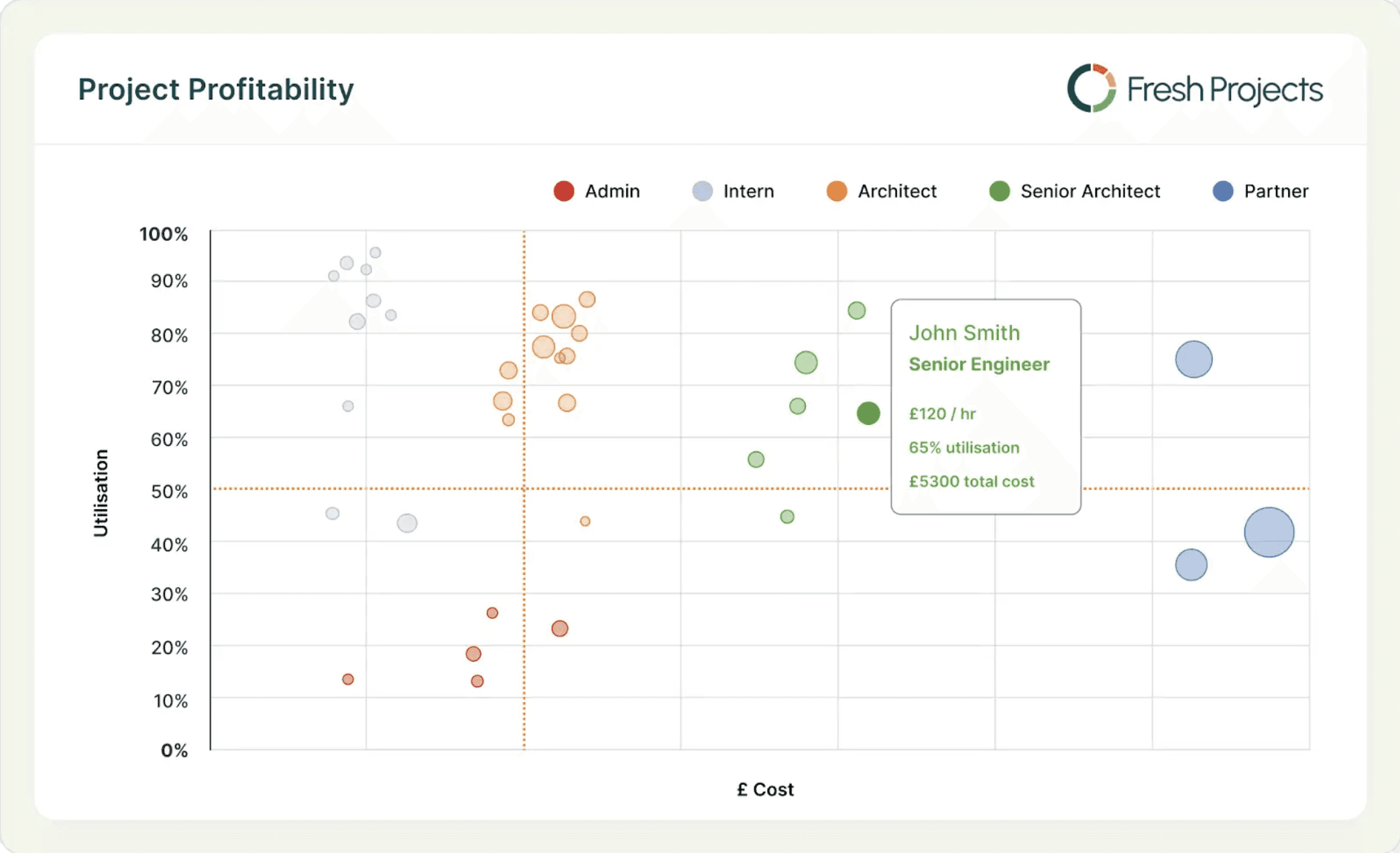
Image reference: Fresh Projects scatter chart
Managing scope creep effectively
Scope creep, the expansion of work beyond the original agreement, can quickly erode margins if not managed proactively.
Prevention strategies
To manage scope creep effectively, firms should:
Agree and sign clear contracts that define inclusions, exclusions and rates for additional work
Establish a formal process for handling out-of-scope requests
Track out-of-scope time separately to enable transparent billing and informed decisions
Structured processes and consistent tracking turn scope changes into manageable commercial conversations.
The profit timeline: design versus construction
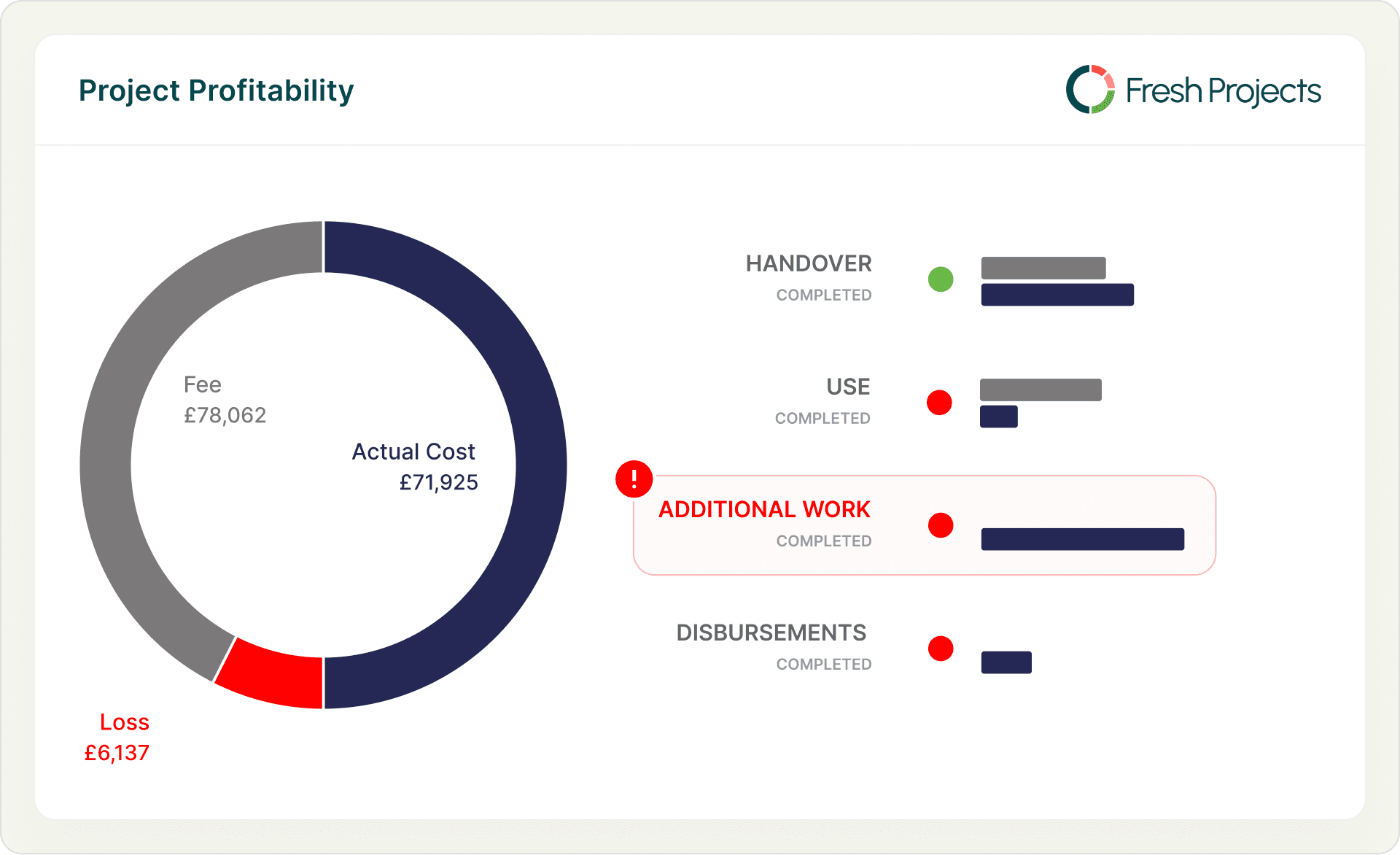
Image reference: Fresh Projects dashboard showing profit distribution across project phases
A common pattern emerges across many projects. Early design stages often generate profit, while margins are eroded during construction. This makes vigilant scope and cost management particularly important later in the project lifecycle.
Visualising out-of-scope work
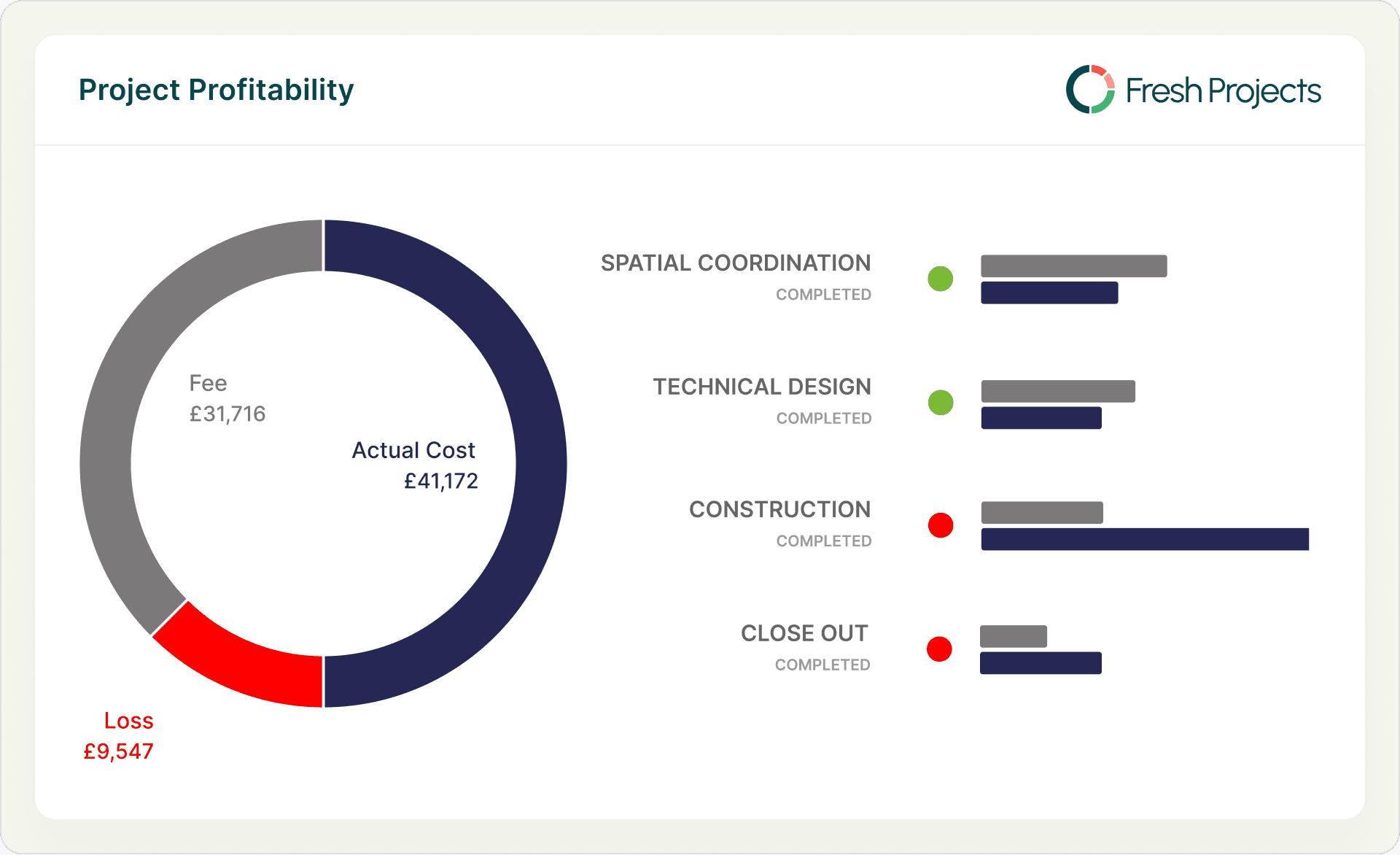
Image reference: Fresh Projects dashboard showing out-of-scope tracking
Separately tracking additional time and expenses serves two purposes:
It provides evidence to support additional fee requests
It explains why a project may have underperformed financially
Turning scope creep into a profit centre
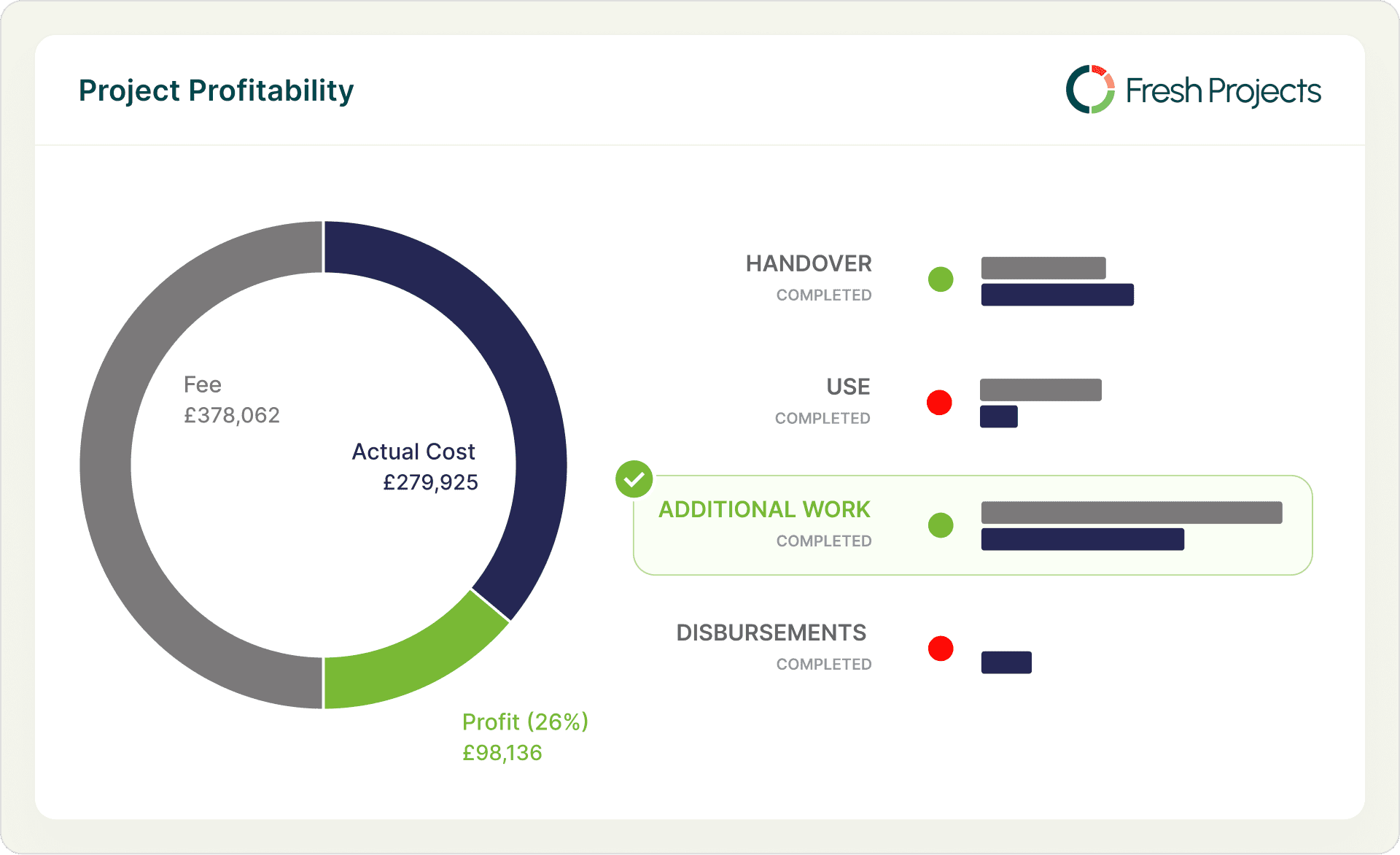
Image reference: Fresh Projects dashboard showing scope creep as a profit centre
Some firms are reframing scope creep as an opportunity rather than a threat. By rigorously tracking and pricing variations, they maintain or even increase profitability as projects evolve.
One firm working on a mixed-use development successfully negotiated additional fees for extensive design changes by presenting clear, data-backed evidence of additional effort. Despite significant scope expansion, the project remained profitable.
Conclusion: the path to profitable projects
Profitable AEC projects are built on strong foundations. Bottom-up fee setting, real-time cost tracking and disciplined scope management all play a critical role.
Tools like Fresh Projects support this approach by providing visibility and structure that allow firms to protect margins while continuing to deliver high-quality work.
In the next articles in the series, we will explore:
Together, these form a practical framework for improving profitability across your practice.
Profitable Projects: A Three-Part Series on AEC Profitability
Welcome to Profitable Projects, a three-part series designed to help Architecture, Engineering and Construction firms improve project profitability.
Across the series, we explore three fundamentals of financial performance in AEC practices:
Setting the Right Fee for Success (you are here)
Each article focuses on practical, data-led strategies that reflect how AEC firms operate today.
Mastering the art of fee setting in AEC
In architecture and engineering, profitability hinges on a careful balance of cost control, project management and client communication. Few decisions have a greater impact on that balance than how fees are set.
Set fees too low, and even well-run projects struggle to perform financially. Set them correctly, and profitability becomes far more predictable.
The foundation: getting the fee right
Percentage-based fees versus bottom-up calculation
Many firms still rely on percentage-based fees, often guided by industry benchmarks. While familiar, this approach frequently breaks down on complex or non-standard projects.
A more reliable method is bottom-up fee calculation, where the fee is built directly from the defined scope of services and the cost to deliver them.
From Fresh Projects data, projects using bottom-up fee calculations consistently achieve stronger profit margins than those relying on percentage-based pricing. This reflects the value of grounding fees in real effort rather than assumptions.
Defining the scope of services
A clearly defined scope of services is essential for fair compensation and effective expectation management.
A detailed scope protects against scope creep and creates a clear commercial framework for managing change. Where scope is well defined, variations are far more likely to generate additional profit rather than erode margins.
This makes upfront clarity one of the most commercially valuable steps in the project lifecycle.
Calculating delivery costs accurately
Effective fee setting requires a clear understanding of delivery costs. This includes:
Labour effort by role and project stage
Hourly cost rates that account for utilisation and overheads
Direct project expenses
Without this level of detail, fees are often set too low to recover the true cost of delivery.
Quantifying project value
Bottom-up pricing should reflect more than cost recovery alone. It should also consider the value delivered to the client.
As one industry commentator put it, value pricing is not about charging what you are worth. It is about charging what the client values.
For example, an engineering firm that designs a sustainable office building delivering meaningful energy savings can quantify that long-term benefit and reflect it in the fee.
Image reference: X (Twitter) – @mwmoedinger
Tracking projected costs throughout the project
Even well-priced projects can lose profitability if costs are not tracked in real time.
Direct project costs
Expenses such as supplier invoices and travel should be tracked against each project and billed where appropriate. Linking direct costs to projects improves recovery and reduces leakage.
Time costs
Labour typically represents the largest cost in AEC firms. Tracking time accurately, including overhead allocation, allows practices to identify overruns early and take corrective action.
Visual tools such as scatter charts often reveal how time is actually being spent across different roles. These insights frequently highlight senior staff spending a disproportionate amount of time on administrative work rather than fee-earning delivery.
Pro tip
In many firms, partners and directors spend significant time running the business. Delegating procedural and financial tasks to lower cost roles often delivers a meaningful uplift in profitability by freeing senior staff to focus on high-value project work.
Image reference: Fresh Projects scatter chart
Managing scope creep effectively
Scope creep, the expansion of work beyond the original agreement, can quickly erode margins if not managed proactively.
Prevention strategies
To manage scope creep effectively, firms should:
Agree and sign clear contracts that define inclusions, exclusions and rates for additional work
Establish a formal process for handling out-of-scope requests
Track out-of-scope time separately to enable transparent billing and informed decisions
Structured processes and consistent tracking turn scope changes into manageable commercial conversations.
The profit timeline: design versus construction
Image reference: Fresh Projects dashboard showing profit distribution across project phases
A common pattern emerges across many projects. Early design stages often generate profit, while margins are eroded during construction. This makes vigilant scope and cost management particularly important later in the project lifecycle.
Visualising out-of-scope work
Image reference: Fresh Projects dashboard showing out-of-scope tracking
Separately tracking additional time and expenses serves two purposes:
It provides evidence to support additional fee requests
It explains why a project may have underperformed financially
Turning scope creep into a profit centre
Image reference: Fresh Projects dashboard showing scope creep as a profit centre
Some firms are reframing scope creep as an opportunity rather than a threat. By rigorously tracking and pricing variations, they maintain or even increase profitability as projects evolve.
One firm working on a mixed-use development successfully negotiated additional fees for extensive design changes by presenting clear, data-backed evidence of additional effort. Despite significant scope expansion, the project remained profitable.
Conclusion: the path to profitable projects
Profitable AEC projects are built on strong foundations. Bottom-up fee setting, real-time cost tracking and disciplined scope management all play a critical role.
Tools like Fresh Projects support this approach by providing visibility and structure that allow firms to protect margins while continuing to deliver high-quality work.
In the next articles in the series, we will explore:
Together, these form a practical framework for improving profitability across your practice.
Published:
Published:


Why Reporting Still Leaves Architecture and Engineering Firms Guessing
Why Reporting Still Leaves Architecture and Engineering Firms Guessing
Why Reporting Still Leaves Architecture and Engineering Firms Guessing
Inside many built environment firms, meetings meant for decisions quietly turn into debates about the numbers on the page.
Inside many built environment firms, meetings meant for decisions quietly turn into debates about the numbers on the page.
Read More
Read More

If One Office Says “That’s Not How We Do It”, Leadership is Flying Blind
If One Office Says “That’s Not How We Do It”, Leadership is Flying Blind
If One Office Says “That’s Not How We Do It”, Leadership is Flying Blind
In many built environment consultancies, reporting technically works. The challenge is that clarity often arrives after the moment when it would have influenced action.
In many built environment consultancies, reporting technically works. The challenge is that clarity often arrives after the moment when it would have influenced action.
Read More
Read More

Why Reporting Still Slows Down Established Firms Delivering Services in the Built Environment
Why Reporting Still Slows Down Established Firms Delivering Services in the Built Environment
Why Reporting Still Slows Down Established Firms Delivering Services in the Built Environment
Even with reporting systems in place, many architecture, engineering and quantity surveying firms find that insight arrives too late to influence decisions during delivery.
Even with reporting systems in place, many architecture, engineering and quantity surveying firms find that insight arrives too late to influence decisions during delivery.
Read More
Read More

How to Compare Practice Management Tools for Architect and Engineering Firms in 2026
How to Compare Practice Management Tools for Architect and Engineering Firms in 2026
How to Compare Practice Management Tools for Architect and Engineering Firms in 2026
Choosing a practice management system is no longer about feature lists. This guide explains how architecture and engineering firms should compare tools in 2026, focusing on adoption, usability and decision-making rather than complexity.
Choosing a practice management system is no longer about feature lists. This guide explains how architecture and engineering firms should compare tools in 2026, focusing on adoption, usability and decision-making rather than complexity.
Read More
Read More

Autumn Budget 2025: What It Means for Architecture and Engineering Firms
Autumn Budget 2025: What It Means for Architecture and Engineering Firms
Autumn Budget 2025: What It Means for Architecture and Engineering Firms
Implications for resourcing, margins and medium-term planning
Implications for resourcing, margins and medium-term planning
Read More
Read More

How Larger Architecture and Engineering Firms Stay Profitable in a Slower Construction Market
How Larger Architecture and Engineering Firms Stay Profitable in a Slower Construction Market
How Larger Architecture and Engineering Firms Stay Profitable in a Slower Construction Market
What 50–100 person practices are tightening up when pipelines soften
What 50–100 person practices are tightening up when pipelines soften
Read More
Read More

Why Traditional Reporting is Holding A&E Firms Back
Why Traditional Reporting is Holding A&E Firms Back
Why Traditional Reporting is Holding A&E Firms Back
Why Traditional Reporting is Holding A&E Firms Back
Why Traditional Reporting is Holding A&E Firms Back
Read More
Read More

Spreadsheets in A&E Firms: Usage, Key Features, and Underappreciated Gems
Spreadsheets in A&E Firms: Usage, Key Features, and Underappreciated Gems
Spreadsheets in A&E Firms: Usage, Key Features, and Underappreciated Gems
A practical guide to using Excel and Sheets well, and knowing when to graduate to purpose-built systems without losing the flexibility you love.
A practical guide to using Excel and Sheets well, and knowing when to graduate to purpose-built systems without losing the flexibility you love.
Read More
Read More

Breaking Barriers in AEC: Meet the Women Driving Fresh Projects
Breaking Barriers in AEC: Meet the Women Driving Fresh Projects
Breaking Barriers in AEC: Meet the Women Driving Fresh Projects
Why representation, visibility and better systems matter for the future of architecture and engineering
Why representation, visibility and better systems matter for the future of architecture and engineering
Read More
Read More

Legacy Firms, Future Focus: Why Architecture’s Crossroads Is a Leadership Moment
Legacy Firms, Future Focus: Why Architecture’s Crossroads Is a Leadership Moment
Legacy Firms, Future Focus: Why Architecture’s Crossroads Is a Leadership Moment
How firm leaders can protect margin, prepare successors and modernise delivery without losing what made them successful
How firm leaders can protect margin, prepare successors and modernise delivery without losing what made them successful
Read More
Read More

Outgrowing Spreadsheets: 5 Ways to Maintain Profitability as Your Firm Grows
Outgrowing Spreadsheets: 5 Ways to Maintain Profitability as Your Firm Grows
Outgrowing Spreadsheets: 5 Ways to Maintain Profitability as Your Firm Grows
How architecture and engineering practices protect margin as teams and project complexity increase
How architecture and engineering practices protect margin as teams and project complexity increase
Read More
Read More

The Profitability Pyramid: Where UK Architecture Firms Make and Lose Money
The Profitability Pyramid: Where UK Architecture Firms Make and Lose Money
The Profitability Pyramid: Where UK Architecture Firms Make and Lose Money
Understanding the real drivers of financial performance for medium and large practices over the past year
Understanding the real drivers of financial performance for medium and large practices over the past year
Read More
Read More

3 Lessons to Help You Run a More Profitable Practice
3 Lessons to Help You Run a More Profitable Practice
3 Lessons to Help You Run a More Profitable Practice
Practical insights from A&E leaders on spotting profit risks early, communicating value, and protecting margins
Practical insights from A&E leaders on spotting profit risks early, communicating value, and protecting margins
Read More
Read More

Embracing Neurodiversity in Architecture
Embracing Neurodiversity in Architecture
Embracing Neurodiversity in Architecture
How inclusive practice design can unlock creativity, innovation and operational clarity
How inclusive practice design can unlock creativity, innovation and operational clarity
Read More
Read More

Profitable Projects: Winning the Right Projects in AEC
Profitable Projects: Winning the Right Projects in AEC
Profitable Projects: Winning the Right Projects in AEC
How to qualify leads, focus your pipeline and forecast success more confidently
How to qualify leads, focus your pipeline and forecast success more confidently
Read More
Read More

Profitable Projects: The Art of Cashflow Alchemy in AEC
Profitable Projects: The Art of Cashflow Alchemy in AEC
Profitable Projects: The Art of Cashflow Alchemy in AEC
How architecture and engineering firms can turn unpredictable cash flow into a strategic advantage
How architecture and engineering firms can turn unpredictable cash flow into a strategic advantage
Read More
Read More
Profitable Projects: A Three-Part Series on AEC Profitability - Setting the Right Fee for Success
Profitable Projects: A Three-Part Series on AEC Profitability - Setting the Right Fee for Success
Profitable Projects: A Three-Part Series on AEC Profitability - Setting the Right Fee for Success
Why bottom-up fee setting, clear scope and real-time cost visibility underpin profitable projects
Why bottom-up fee setting, clear scope and real-time cost visibility underpin profitable projects
Read More
Read More

How Firm Management Tools for Architects and Engineers Drastically Increase Profits
How Firm Management Tools for Architects and Engineers Drastically Increase Profits
How Firm Management Tools for Architects and Engineers Drastically Increase Profits
Why better visibility across projects, people and finances is now essential for sustainable practice performance
Why better visibility across projects, people and finances is now essential for sustainable practice performance
Read More
Read More

How to Manage Inflation on Architecture Projects
How to Manage Inflation on Architecture Projects
How to Manage Inflation on Architecture Projects
Practical ways to protect fees and margins when costs change mid-project
Practical ways to protect fees and margins when costs change mid-project
Read More
Read More

An Architect’s Guide to Project Budgeting
An Architect’s Guide to Project Budgeting
An Architect’s Guide to Project Budgeting
How to build realistic, profitable project budgets that support better pricing and delivery
How to build realistic, profitable project budgets that support better pricing and delivery
Read More
Read More

An Architect’s Guide to Managing Scope Creep
An Architect’s Guide to Managing Scope Creep
An Architect’s Guide to Managing Scope Creep
How to protect fees, margins and client relationships when projects change
How to protect fees, margins and client relationships when projects change
Read More
Read More

Improve Project Profitability: An Architect’s Guide
Improve Project Profitability: An Architect’s Guide
Improve Project Profitability: An Architect’s Guide
Practical ways architecture practices can protect margins and make better commercial decisions
Practical ways architecture practices can protect margins and make better commercial decisions
Read More
Read More

Pricing Methods for Architects: How to Price Architecture Services
Pricing Methods for Architects: How to Price Architecture Services
Pricing Methods for Architects: How to Price Architecture Services
When to use hourly rates, fixed fees or percentage pricing, and how to choose with confidence
When to use hourly rates, fixed fees or percentage pricing, and how to choose with confidence
Read More
Read More

Calculate Your Cost Rate in 3 Simple Steps
Calculate Your Cost Rate in 3 Simple Steps
Calculate Your Cost Rate in 3 Simple Steps
Why understanding your true cost rate is the foundation of profitable fees, resourcing and decision-making
Why understanding your true cost rate is the foundation of profitable fees, resourcing and decision-making
Read More
Read More

When to Hire? Three Factors That Will Change How You Think About Resourcing
When to Hire? Three Factors That Will Change How You Think About Resourcing
When to Hire? Three Factors That Will Change How You Think About Resourcing
Why workload visibility and forecasting matter more than instinct in mid-sized architecture practices
Why workload visibility and forecasting matter more than instinct in mid-sized architecture practices
Read More
Read More

Didn’t Reach Your Profit Goals Last Year? Get These 5 Basics Right This Year
Didn’t Reach Your Profit Goals Last Year? Get These 5 Basics Right This Year
Didn’t Reach Your Profit Goals Last Year? Get These 5 Basics Right This Year
Five practical habits that help architecture practices improve profitability without adding complexity
Five practical habits that help architecture practices improve profitability without adding complexity
Read More
Read More

3 Questions Every Profitable Architecture Practice Can Answer
3 Questions Every Profitable Architecture Practice Can Answer
3 Questions Every Profitable Architecture Practice Can Answer
How clear insight into projects, clients and utilisation drives better decisions in mid-sized A&E firms
How clear insight into projects, clients and utilisation drives better decisions in mid-sized A&E firms
Read More
Read More

Is There a Secret to Being a Profitable Architecture Practice?
Is There a Secret to Being a Profitable Architecture Practice?
Is There a Secret to Being a Profitable Architecture Practice?
Why the most profitable firms spend less time on financial management and still make better decisions
Why the most profitable firms spend less time on financial management and still make better decisions
Read More
Read More

The “A Team” Approach: How a Simple Change Can Improve Profitability
The “A Team” Approach: How a Simple Change Can Improve Profitability
The “A Team” Approach: How a Simple Change Can Improve Profitability
Why reallocating work across roles can dramatically improve utilisation and margins in 50–100 person A&E practices
Why reallocating work across roles can dramatically improve utilisation and margins in 50–100 person A&E practices
Read More
Read More

I Love Excel. I Hate Excel.
I Love Excel. I Hate Excel.
I Love Excel. I Hate Excel.
Why spreadsheets break down in 50–100 person architecture and engineering practices, and what works better
Why spreadsheets break down in 50–100 person architecture and engineering practices, and what works better
Read More
Read More

Getting Project Fees Right in Large Architecture and Engineering Firms
Getting Project Fees Right in Large Architecture and Engineering Firms
Getting Project Fees Right in Large Architecture and Engineering Firms
How accurate budgeting and disciplined scope control protect profitability in 50–100 person A&E practices
How accurate budgeting and disciplined scope control protect profitability in 50–100 person A&E practices
Read More
Read More

Why Hidden Working Capital Is the Silent Risk in Large Architecture and Engineering Firms
Why Hidden Working Capital Is the Silent Risk in Large Architecture and Engineering Firms
Why Hidden Working Capital Is the Silent Risk in Large Architecture and Engineering Firms
The financial blind spot that catches even well-run architecture and engineering practices
The financial blind spot that catches even well-run architecture and engineering practices
Read More
Read More

How Large Architecture and Engineering Firms Win More of the Right Jobs
How Large Architecture and Engineering Firms Win More of the Right Jobs
How Large Architecture and Engineering Firms Win More of the Right Jobs
How Large Architecture and Engineering Firms Win More of the Right Jobs
How Large Architecture and Engineering Firms Win More of the Right Jobs
Read More
Read More
Fresh Projects is a UK-based software platform designed for architects, engineers, and other built-environment professionals to manage financial aspects of their projects. It helps teams track fees, timesheets, expenses, billing, and overall profitability to keep projects on budget and profitable. The platform also centralises project data, streamlines administrative tasks, and offers mobile app support for easy access and updates.
1a Colinette Road
London
SW15 6QG
© 2026 Fresh Projects
Product
